the plagal cadence
an asking for, not of a deference to, not from a conquered heap of, well, what we imagine inside, our hands clasped, slick with ambiguity, or was i, ready to leave, an amen on your doorstep, a fear of the word, a fear of god, oh, a want of that fear, to flood your doorstep, fear on fear, on fear, on fear, of the flood itself, a word, of us, afraid of us, enfeared and fired and aflame, a slow fire of fearing, a word aflame, a flame worded, a doorstep darkened, our flood is laden with fire words, and fears to enflame.
nadeshiko
we are in a land of stately pinks erupting pyroclastic, the stateless continent of a sooty god. but we, ourselves, are born of the steam: flame meeting surf, a violent expansion rather than a subtle extinguishment.
you are sitting at a piano, poor posture and all, playing a monochromatic nocturne. you chortle because whoever would put a piano next to a bathroom. you close the lid, and set the wood alight. the strings start to snap.
our skin sings for its supper. there are many mouths to be fed and i have never hosted a banquet. you tell me that there is a campfire on the riverbank, and there are many fish to cut, scale, and cook.
i am in the kitchen making you breakfast and i am also in the store buying sorbet on the hottest day of the year. we are in the jungle, again. you are busy making ice from fire and all i can dream of is freezing to death.
you sing a refrain: going anywhere but where we are. you say: play whatever pleases us as long as we can. hammers fall into each other and i cannot sing along. the stove clacks as the kettle intones that it’s the end of the shift.
the keys melt into each other. the river is dirty and you want to push the piano in it. it starts collapsing. my breast fills with a chorus. i grab matches, a canteen, and fifty dollars. the rime around me breaks in the sticky air.
a felting
burlap around legs and heat and, you can’t find enough hot water here. there are four or five needles that are to be applied over, and over, and over, into an interlocking to gasp out a breathless not. a gust rails the lonesomeward towards the four or five needles. there is a patch at the base of your neck awaiting a signal. your hand on a stopwatch, hearing the clack of needles and the clack of relays.
pantograph rising into to contact, three, or four clacks: the shoe, felt and feeling, not on the bogie. stop looking down when i talk to you, you: oh, a double you — a mirror you, staring back at yourself. you put the needle into the mirror and it reaches the double you. you have three or four needles left and there are no longer any pages in your book of sorts. a needle to the chin finds its home yet you still commute the long way.
a hussle and a lye for her needle and your thimble. a thumb below your orbit tracing a path at grade. a severe and several series of papercuts on your palm weep for the approach release. a pause at the junction, a needle out the windle, gone for good. are there two or three left, she asks? your yellow blinks twice, but you can’t recall how the fibers began to lock together. a whistle and an overheated bearing exhausted the future.
a hand inside the ceaseless stitching can feel and be felt. flanks bear the seas and ohs as you approach the manse. there is not enough space to fit more needles and our fibers are too tight and locked. one needle gets stuck in a shoe and another brakes the air of continuity. you swore there was one more and there must be a world in which you wooled. a fiber whistles and a patch at the base of your neck becomes unravelled.
callippe
terror strikes in the slow afternoon of escape: a tide of mordancy lapping at my toes, a stitch in my ribs leaving me gored and trembling. there are clamors of oranging poppies everywhere i’m trying to cling to. this escape might be the last in the way that each of them might have been. we found each other at one of those times: in a wave of terror to be caught and surfed with abandon.
half-expecting to be caught up in your horns i bobbed along the surface, not adrift, but saving my energy. the purpling lights told a different story: soft focus, gentle reveal, no jumpcuts, even as i lay spatchcocked and dreaming of how i feel when i see the poppies, the ones you told me you didn’t know about. i swore to you they’re everywhere here, a cup of gold running over.
something breaks the fog of the afternoon’s motion sickness: there’s a mist of longing rolling in from the hills, a regal light on the horizon, and the smell of trust in the air. we feel ourselves heading back towards the hills. yellow pansies stellate the grasslands between the poppies, ready to be consumed by hungry larvae, your smile ringing like shrill dinner bell in the grass.
the blue line swinger
a pair of trembling eyes, tracing shadows cast from blank referents quivering and interpreting through dust-filled, thin, curious tears expecting moldering blueprints.
watching me watching you, the lamp off: you won’t talk about the lines, any of them, who drew them, their vanishing points, perspectives, or how they were drawn on your arms.
during our uncertain twilight my small red eyes interlacing the blue lines, observing the nodes emerging as nests of loose ends and umbral morse telegraphy.
beyond dots and hazy shadows i know the world ends at sunrise. possibilities flourish: in the violet hour of want, an exploded drawing of desire and symbol lets us assemble.
cluttering
her hands don’t wait for much these days, not even telephone calls: she skulks too slowly to merit even half the attention she used to receive. her eyes shift backwards, looking at a history in the air cordoned off from view, lit from minuscule recesses and warrens. she takes a breath that hangs heavy in the air: sighs built from volcanic ash and barely audible, sulphuric wails. a cough makes its way the edge of her parched tongue. she stifles it as much as she can, her unfiltered breaths precious and in demand. she looks deeper at the glistening corners and sees faces: her own, and those of her sisters, growing increasingly indistinct. a dry wind tickles her throat and the inside of her nostrils. keep listening, she thinks, they might hear you after all, above all this wind. three whistles blow and the faces go pale and out of focus, scattering like rats. rats, she thinks, they’ve eaten through my memories. the lights are no longer the memories, just phosphorescent vermin shit. a broom and dustpan tumble off the wall. they’re on the loose again, going through the boxes and eating through the glue. her synapses shudder and go dim as she flicks on the lights, which clatter into a milky glow. slivers of chewed cardboard, droppings, and torn papers lead into a spiral trail into the center of the room. the only way through is out.
a tear in the sky
she looks at her reflection and finds a pair of purple eyes sprouting from her shoulders. they look back at her demanding answers and attention. she imagines how she was pinned so effortlessly to the mattress: a butterfly on a mount with its thorax pierced. she thinks of her own thorax being pierced, divided into shards through sharp implements she can only feel, not see. her skin feels hot and demanding, and through her own senseless craving she opens her chest wall. unfolding her circulatory system, she waits, trembling with each pulse, red to purple to blue and back again. two bodies loom over her, watching and waiting to split the spoils that remain. they call her names: a senseless little slut, needy, unworthy of attention. she stares back, and hears her name. she feels bracketed by one’s arms as the other rends her flesh for sport. she can no longer see anything but a purple tear in the sky, trembling with her own pulse. she can no longer hear anything but her own name and her own respiration. they see her kicking, gasping, flopping like a fish fighting for its last breath. she feels still, at peace, adrift on a punt, staring at the tear in the sky. she eats cherries whole and dreams of a warm breeze in her hair. they continue feasting on her, tasting the warmth of bitter almond and sweet summer air. they begin to see what she sees: two, then three tears in the sky, ripening and intersecting into a larger whole.
basking in puce
polished metals and precious stones are so intrinsically transporting that even a victorian, even an art nouveau jewel is a thing of power. and when to this natural magic of glinting metal and self-luminous stone is added the other magic of noble forms and colours artfully blended, we find ourselves in the presence of a genuine talisman. (aldous huxley, “heaven and hell”)
amid a bit of uncertainty in my life i have been holding on to certain experiences tight as a way to savor them for longer than i’d be able to. perhaps i’d be better served by the ephemerality of some of these experiences, but i am entranced by the way they catch the light: they glimmer and fracture beams as a collection of prisms. i film these experiences in a way that feels timeless, or, more correctly, “out of time.” and perhaps it’s intentional, but these are exactly the experiences i chase, craving them both for novelty and timelessness as a kind of transcendence. maybe i can’t reproduce them, but i can try reproduce the feeling as a way to relish those memories - to make them out of time, out of place, and perhaps even positively anachronistic.
the latest instance of this was having an extremely extravagant fine dining experience earlier this week for my birthday. i was accompanied by someone for whom i have a great deal of affection. the restaurant itself is architecturally a crown jewel of northwestern 1950s modernism. as we sat in the lounge for a predinner beverage, my companion pointed out a gentle incongruity — the interiors felt different, very 1970s. i looked around as i sat on a banquette of dark puce velvet and noticed the fibers shimmering while we both mused about how we grew up in 1970s era houses. while nowhere near as fancy as where we found ourselves, we were warmed by the memories of lush carpet, exposed cedar beams, and river stone masonry work that helped rear us.
the rest of the dining experience was similarly timeless, with a stunning array of six courses that brought us to another plane of existence. the evening melted away while we took in beautiful views of water, trees, and bridges, and felt out of time. the light itself here was stunning: the approach of twilight, the boats and piers along the ship canal after night descended, and how each morsel on our plates, our place settings, and glassware winked us and seduced us into engagement. the first large course’s muted colors stuck out to me as well, as a small purse of cabbage and sablefish laid upon a puce-colored bed of mushroom and hazelnut puree. even departing the restaurant was an experience of light, with the muted glow of the the sign next to the entrance and valet carport beckoning us back as a slowly fading hearth might – possibly whispering a longing “don’t forget about us.” and really, how could i?
as i was lost in my thoughts yesterday, i remembered that some film makes me feel this way, and i remembered an eternal favorite: kenneth anger’s “puce moment." while only a mere six minutes, this was a film that i’ve clung to as if my life depended to it. i was in my early 20s when i watched yvonne marquis, anger’s seemingly timeless starlet, smile widely, flirt and envelop herself in sequins, apply perfume from an absurdly large emerald green bottle, lounge peacefully, and walk a pack of borzois. it was intoxicatingly out of time on its own: “a film that /feels/ like something from the 1960’s, produced in the late 1940’s, looking back to the 1920’s." as a mildly clueless college student it was exactly what i was looking for: the exotic without exoticizing, ecstatic in ways that i would be unable to describe for anyone else. i was being invited into a world i couldn’t have experienced otherwise without that invitation.
my inclination, as always, was to find more ways to cling to these puce moments: in writing and in a playlist. each is different, each intersect one another. the words recall how we can mark time through rhythm and serve to /refract/ the experience rather than reflect it. the playlist approaches this similarly. with these two things in mind i want to encourage us to open ourselves up for a litany of reasons. can we refract the feeling through sound? can we make things boundless enough so that we allow ourselves to become awash in the wonder of having an experience with someone where time itself becomes a fiction - where we bathe in huxley’s preternatural light to “evoke, from the boundless chaos of night, rich island universes … the glitter of metal and gems, [and] the sumptuous glow of velvets and brocades”? (huxley, again.) that, my friends, is where i cast my eyes - the place where i can weave everything together into an ecstatic celestial tapestry.
saccharine rudiment
two pulses ache under silk breast and breeze one mint-lime, lavender, burnt and teary another: heady musk-soaked tomatoes syncopate out of phase tender pulses: triple it, trip, pull it, ratamacue. oh, why me? why not you? two bald questions skipping beats, pulsing through ceaseless aching trembling tongues swollen thick with puce compote, together reveling, beating senseless soft patterns into skin, tendon, muscle.
zoochory
a spilling beam splitting down my chest warming through me, a slitting prism. not a drop of inky watery gray today just unsullen blue amid wisp. i have more than enough so it spills from hearth to font to your open hands cupping to drink. our thirsts scrape and rattle in our two throats. hoarse and hoarser, we both need that drop of drink. i long to hear that rattle in your throat speak all the names i long to hear. i long to hear that scraping a song from the treetops and the leaves and the sticky backs of your hands. i long to hear your sticky hands get stuck in my fur and uproot my senses of self: impossibly tenacious, unsettling the ageless questions we thought not to ask. your hands are cooler now, still sticky with the mucilaginous sap from my inner rings. i long to hear my fur still clinging to those hands knowing not what to do or how to let go. three furtive glances become burrs in my side, looking for their next fertile fields: the swell of my stomach, tangles of ganglia, and the shady recesses of my gray matter. we both drink deep, your seedpods swelling between my vertebrae, working to break my back even further, to climb my spine in the name of reaching heaven.
fractured eyes
an eye writes and writhes i/t-self. the pear an eye breaks in/to when it catches i/ts reflection in the mirror. the pear an eye-pear unst/i/tched in/to when be/held by another eye, another ewe. no matter what the wether. wether an eye is now a ewe is not a question for you to flock in/to. there is only ewe and eye not a ram in this world. eye be/holding ewe. no matter what the wether or what ewe in/to. a pear of ewe can i/t-self st/i/tch an eye-pear back in/to one eye. an eye may try to st/i/tch a pear of ewe in/to one ewe, but must be st/i/tched i/t-self first. no matter what eye am in/to. no matter what ewe are in/to. no matter wether ewe and eye are in/to eye and ewe. no matter we are no longer an eye-pear and ewe-pear.
cerasus
taken aback that cherry blossoms were still there. tree upon tree, bough upon bough. i remember when the slightest raindrop, like a cartoon tear, could rattle them down, clinging to damp pavement. monotone sky saying: oh no, it is not your time yet. sickly sweet perfume; too sweet, like you, someone says. i am but here for a short time and so are all of us. i want to smash that monotone sky into a thousand shards.
i went to the park and all the cherry trees sang your praises. fluttering slow petals, shaken loose by breezes. one fell at my feet, another on my head. why must i bathe in petals, i muttered to no one. oh, no, it is not my time yet. more and more were falling and more and more clung to me. an unfamiliar warm body. bathe me in the petals, the slow snowfall of pink and white, a watermelon snow, cloaking the heart, as it pumps white and pink just for show.
the petals bathe the slow machine of the body. some of us are the machines that say: oh, no, it is not your time yet. some of us are the machines that say: keep quiet and relax. these machines cannot fix one another; the machines cannot fix a lack, only repeating their ceaseless message in a system of messages. pay attention to it.
pay attention to that wood in that world of the would, the wood of the mature cherry orchard. unword that would with a must: the musk of work to let the blooms fall where they may. separate the juice from fruit and pit from skin. oh, no, it is not my time yet. the wine is too young, it must age and rest. let a must lie on lees in a barrel of would. may might be just around the corner.
washing and anointment of the feet
the intention of this ritual is to establish a bond of service (ideally mutual but without expectation or obligation), strength, and protection between two lovers through an act of humility.
prefatory notes on washing and anointing of the feet
to inform ritual, look to 1 Samuel 25:41, John 12:3, and Song of Songs 1:12-14, as well as Song of Songs 4:13. the first two relate to the intersection of women (Abigail and Mary of Bethany) performing footwashing as a form of service. look to the later two for how to inform anointment.
stepwise, i think we are looking at:
- draw the footbath;
- add whatever supplements to the water (e.g. epsom salts, rose petals);
- dry with linen towel (or symbolically, your hair);
- anoint feet with hands, including massage.
components of anointing oil
generally look to the work of cat yronwode as a good reference for herbs, etc. while mercantile see [7], and maybe look at thelemapedia [8] to dig into perfumes. in all, thes are fairly love-oriented, but we want a good base and we want positive and not forced guidance. (i’m RHP!)
- spikenard: love or commitment oriented (compare with civet or other musks in thelema)
- myrrh: healing, purification, protection, romance
- henna: perhaps as a sigil expression medium? [2] presumes using as a form of ink, though.
- frankincense: “strengthen” by way of reference to holy oil(s) [3]; corresponds to Tiphareth [9]
- saffron: love, strength, etc. [4]
- cinnamon: business and money (meh) but also love and protection.
- aloe: stops evil talk. again, may want to exclude as RHP. but in thelema/qabalah, corresponds to the Path of Lamed, associated with the Justice card in tarot. [5], [6]
requiring careful consideration:
- calamus: in hoodoo, calamus is used for control and domination (see [1]) so if we’re going RHP in ritual we may want to avoid it or using it extremely sparingly. it’s also toxic to ingest. mathers substituted calamus with galangal in his version of oil of abramelin. [10]
- pomegrante: associated with the Path of Yod [11] indirectly (cf. image of the Yod decan). consider avoiding through connection to the underworld (cf. Persephone) yet also consider including because of links to the Eleusinian Mysteries. yronwode notes that pomegranates are often used in an offering to Shango. [12]
1 Samuel 25:41
וַתָּקָם וַתִּשְׁתַּחוּ אַפַּיִם אָרְצָה וַתֹּאמֶר הִנֵּה אֲמָתְךָ לְשִׁפְחָה לִרְחֹץ רַגְלֵי עַבְדֵי אֲדֹנִי = 4406 [And she arose and bowed herself on her face to the earth and said Behold let thine handmaid be a servant to wash the feet of the servants of my lord = 7188]
gematric parallels of 4406:
וְיִֽהְי֣וּ תֹֽאֲמִים֮ מִלְּמַטָּה֒ וְיַחְדָּ֗ו יִהְי֤וּ תַמִּים֙ עַל־ רֹאשֹׁ֔ו אֶל־ הַטַּבַּ֖עַת הָאֶחָ֑ת כֵּ֚ן יִהְיֶ֣ה לִשְׁנֵיהֶ֔ם לִשְׁנֵ֥י הַמִּקְצֹעֹ֖ת יִהְיֽוּ׃ (= And they shall be coupled together beneath and they shall be coupled together above the head of it unto one ring thus shall it be for them both they shall be for the two corners; Exodus 26:24) “their world is connected with your world”
John 12:3
ἡ οὖν Μαριὰμ λαβοῦσα λίτραν μύρου νάρδου πιστικῆς πολυτίμου ἤλειψεν τοὺς πόδας τοῦ Ἰησοῦ καὶ ἐξέμαξεν ταῖς θριξὶν αὐτῆς τοὺς πόδας αὐτοῦ· ἡ δὲ οἰκία ἐπληρώθη ἐκ τῆς ὀσμῆς τοῦ μύρου. = 17640 Then took Mary a pound of ointment of spikenard, very costly, and anointed the feet of Jesus, and wiped his feet with her hair: and the house was filled with the odour of the ointment.
Song of Songs 1:12-14
[12]: עד־שהמלך במסבו נרדי נתן ריחו׃ = 1567 (While the King sitteth at his table, My spikenard sendeth forth the smell thereof.) [13]: צרור המר ׀ דודי לי בין שדי ילין׃ = 1281 (A bundle of myrrh is my wellbeloved unto me; he shall lie all night betwixt my breasts.) [14]: אשכל הכפר ׀ דודי לי בכרמי עין גדי׃ ס = 1139 (My beloved is unto me as a cluster of camphire [henna blossoms] in the vineyards of Engedi.)
total 3957
Song of Songs 4:13-14
[13]: שלחיך פרדס רמונים עם פרי מגדים כפרים עם־נרדים׃ = 2319 (Thy plants are an orchard of pomegranates, with pleasant fruits; camphire [henna], with spikenard) [14]: נרד ׀ וכרכם קנה וקנמון עם כל־עצי לבונה מר ואהלות עם כל־ראשי בשמים׃ = 2222 (Spikenard and saffron; calamus and cinnamon, with all trees of frankincense; myrrh and aloes, with all the chief spices:)
total 4541
links
- [1] calamus root questions and answers
- [2] seals of solomon and moses questions and answers
- [3] frankincense oil questions and answers
- [4] novice’s grimoire: saffron
- [5] thelemapedia: the path of lamed
- [6] The Path of Lamed
- [7] avraham aromatherapy: kabbalistic “sefirot” blends
- [8] thelemapedia: tree of life:perfumes
- [9] thelemapedia: tiphareth
- [10] thelemapedia: oil of abremalin
- [11] thelemapedia: path of yod
- [12] chango macho
the not knowing: cage and calvinism
it’s been a while since i’ve been deeply unsettled by the lack of resolution in a film, especially if the film’s conceit is overall preposterous. however, having just experienced the disquieting jouissance of such cinematic bombast last night, here i am, with a need to verbalize and process this tormentand whom else would i have to thank for this but my favorite member of the coppola family, nicolas cage, rumplestiltskin of the dramatic arts that he is. what, then, of the film that originated this long-winded introduction of this disquiet from theological and epistemological perspectives? it would be none other than KNOWING (2009, dir. alex proyas). spoilers follow, so be forewarned, lest ye find not your salvation.
i will not go into the plot in depth, but rather obliquely and nonlinearly. as such, the remainder of my writing assumes familiarity with the movie, and i’ll say up front that i’m providing an unalloyed recommendation. if i were to sum it up, however, its major thematic aspects relate to knowledge, faith, other-worldly forces, and the epistemic uncertainty that undergirds all of them. i’m struck by the movie’s refusal to take a clear stance on its major plot points, and thus places responsibility on the viewer to bring its own interpretation to bear. even in moments of it being at its most clear-cut — namely, the penultimate scene of ἀποκάλυψις, a razing of new york city by fire caused by climate change^W^W “solar flares” (i.e. “the wrath of god [that] burns against them” a la jonathan edwards) — an engaged viewer will most notably exclaim “what the actual fuck?” despite this ambiguity, this film is masterfully unsubtle, teeming with intertextual references to christian eschatology across multiple denominations and media, an embarassing use of skepticism as a kind of morality strawman-cum-punching bag, and extremely intense depictions of plausible(!) real-world disasters with mildly sickening CGI.
in terms of its focus on free will, KNOWING initially opens with the conceit of nicolas cage as john koestler, an MIT astrophysicist holding court in an undergrad class opposing free will with some sort of in-between hybrid of nomological determinism and predeterminism. it is here that john, says that he thinks “shit just happens,” and soon after we discover that he’s an atheist academic raised as preacher’s kid that had his latest crisis of faith after his wife died in a horrible hotel fire just days before his birthday. as he becomes obsessed with decoding and identifies the “real life” past and impending catastrophes, we see him bias towards predeterminism, but the as the truth itself is slowly revealed we are supposed to infer that every known cataclysm is delineated as a warning that something is coming for “EE” — everyone else. (it’s giving “this place is a message and is part of a system of messages; pay attention to it.” real “pick me” vibes.) as john dives into to try to stop or save people from terrible things happening (literally sticking his hands in flames to no avail in a failed attempt to save a plane crash victim), he is reminded and humbled by the great futility of his own existence, and his powerlessness in a cruel universe. why are all these things happening? and why do we know the exact predicted death toll?
as we start to realize this, it’s here that i see that the film begins shifting from predeterminism to predestination, and that perhaps, someone in the film is a messenger who will receive this message from the far beyond. it’s clear that the movie’s precocious child characters – john’s son, caleb, and abby, the granddaughter of lucinda, the girl who wrote the numbers that went into the time capsule – are the recipients of the gift of prophecy. but surprise: they’re also special in that they are the elect, bound to bearing the life of the world to come and imminently transported away by these celestial beings. and yet, are they angels? are they aliens? are they both? where does that leave poor old john? fucked in the end: he is not one of the elect. faced with his own spiritual damnation and physical annihilation, he returns to his ancestral home to be with his mildly estranged parents and heavily queer-coded nurse sister.
what’s fascinating to me about this movie is that it refuses to come out and really say what it’s about, and here’s where i disagree with roger ebert. we are supposed to be unsure whether they’re angels or aliens because their depiction is ambiguous. what fascinates me is that the lead writer, ryne pearson, also deliberately plays at that ambiguity. just the same, cage also believes it’s up to the viewer what to take from the movie, and expects that it might stimulate discussion. compare donald barthelme:
this is, i think, the relation of art to world. i suggest that art is always a meditation upon external reality rather than a representation of external reality or a jackleg attempt to “be” external reality. (“not-knowing”)
pearson is apparently a dedicated Catholic, too. these aspects combined make it also all the more fascinating to me that the movie’s themes feel particularly Calvinist: despite our faith and good works, most of us are truly and undeniably bound to suffer. yet as john says goodbye to caleb, and both as foreshadowed by john’s phone conversation to tell his father that the end is nigh and in the koestler family barbecue^W incineration and damnation, there is a presumption of being ready for that next life and being sure that you’ll be reunited in the world to come based on faith – which in some senses is a /not-knowing/.
however, a good Calvinist epistemologist (yes, i’m side-eying Plantinga) might not say this, and may well lead us down a path of something like the presuppositional apologetics of cornelius van til. in these cases, the world of KNOWING seems to suggest that we need to accept that world’s God that makes it possible for an atheist like john to be so rationally minded in the beginning of the movie. john operates in the discursive frame of science and the academy and thus has to perform rationality to be credible. caleb is disappointed when he realizes (early in the movie) that john doesn’t believe in heaven. despite thinking that “shit just happens” and that “we can’t know for sure” (i.e., that heaven exists), at some point in the past john has accepted a presuppositional mindset, which he slowly regains as he sees the truths in the messages. he specifically notes that he lost a form of faith in knowing what was coming while in the throes of grief, which in turn led him to be more nomologically oriented. however, the list of numbers was an intervention that led him to reconsider his loss of faith, because despite how unlikely it might be to an extremely rational astrophysicist, he was called back to accept the presuppositions that inform all of his underlying complexities.
again, we need to remember this was most likely not intentionally a Calvinist apocalypse film. the statements of pearson and cage don’t jive with that. if anything, KNOWING indeed puts the onus on us to observe and dissect the discursive and epistemological frames we look through to square religion and the world. this is perhaps, indeed, why the movie is so baffling - that not even the angel/iens ever describe how or what ever directly to the audience. one cannot simply anticipate what will happen, and that in itself, leads to the revelatory experience of watching this film itself. without prior knowledge, without that grounding, you really have no fucking clue what you’re getting yourself into. with apologies to barthelme, this is:
the combinatorial agility of knowledge and belief, the exponential generation of meaning, once they’re allowed to go to bed together… (barthelme, “not-knowing”)
… the liaison where we can experience the epistemic jouissance of KNOWING.
in a stage whisper: silence, embodiment, and trans* archival praxis
inches give way to lies paint a target on your chest to make it easy for the hunters 🔗
a university librarian at an ivy league writes for an audience of historians about archival silences, and introduces the notion of a “shouty archive”. what? i mean, i suppose it’s an imperfect and relatively powerful metaphor, as the author herself notes, but i’m also not sure it’s really all that illuminating of a point. “archival silences” do exist, and have been widely theorized based informed by the work of michel-rolph trouillot.
i don’t find talking about absolutes all that satisfying. i’ve been thinking a lot lately about the moral claims around access to information and the subtleties that get bulldozed in the name of impossible perfection. archival discourse, like the piece i reference above, talks about correcting silences, and the work of verne harris introduced the notion of “archival whispers”, which trace around the absences and silences.
if the archive is a remnant, it is one that keeps whispering to me, insisting on its place in my everyday life. what i might have said [to an archivist friend] instead is this: “i am a disquieted archive that fumbles in words. a thing made up of infinite, intractiable traces.”
or, i might have simply said: “the archive is a stimulus between myself and myself.” (julietta singh, “no archive will restore you”)
silence, trace, and voice, and the intersection of those aspects as an expression of power by those represented in the records is an area ripe for further study. this is coming to mind more fully lately for a few reasons: 1) the concerns about access to information and the loss of control some of us feel, 2) how to reclaim power as trans folk, 3) what the state of the trans archive(s) to come will be, and 4) how i (or “some of us”) exist on ~gemini~~ as a parallel space.
given these aspects i feel as though it’s only natural to take a step back and think about in some cases why we want to be heard. i don’t feel as though i owe everyone — and, in actually, every trans person i know or meet as well — the dignity of a comprehensive narrative about my life. a presumption of access to that kind of detail, trauma, what have you has to be earned. but i might choose to hint at one thing or another as opposed to publicly posting transition photos online.
however, i do shitpost as much as i earnestpost, and shitposts are a way to make a murmur audible for the right audience. similarly, posting on gemini feels like a bit more of a sacred space in that i can be “freer”. even if i link to my ~gemlog~ micro.blog posts or other writing here, you really need to want to read it if $PLATFORM is not a major part of how you interact with information online. it passes under the radar enough that the average person won’t discover it. together, this it is a subtle form of refusal to be present, or simply be.
since the materiality of the body threatens to eclipse meaning, the voice is neither embodied nor disembodied but /negatively embodied/. that is, the body is incorporated in the voice as a /lack/. whispering, in refusing to surrender the absolute materiality of the body, stages the /lack of a lack/, thus concealing the body from the symbolic scheme. from extreme /intimacy/ to extreme /disembodiment/, whispering constantly oscillates between this pair of dialectic traits, whether in its physiological qualities or its cultural, social, and religious implications. (xinghua li, “whispering: the murmur of power in a lo-fi world”)
this kind of stage whisper, in an archival sense, is a symbolic retreat as a way to control that power. it is a refusal to be fully embodied, fully participatory, fully seeking validation. what i want to see, thus, is forms of trans* archival practice that engage with this: ceaselessly becoming a space for selective voice and register, for spectra of embodiment, for spectra of presence, abundance, and lack.
feast of the third day
- candle lit by lighter and match
- rod and amulet removed from bowl
- old salt cleansed from bowl
- new salt placed in bowl
- plant watered
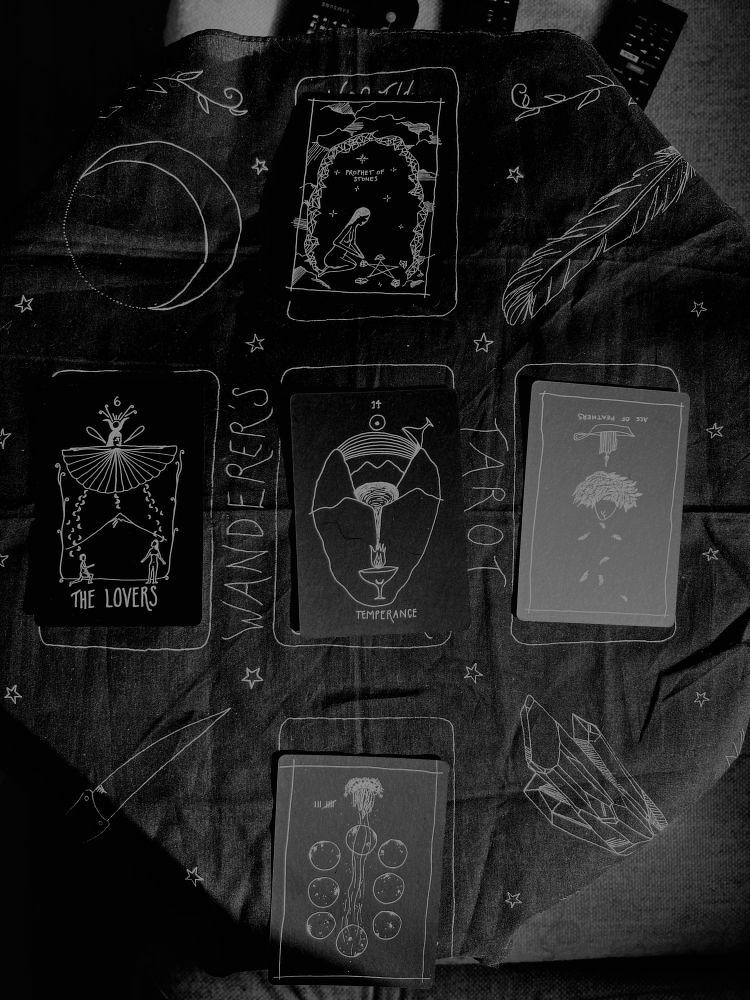
- tarot reading: CESWN - temperance, ace of wands reversed, 8 of moons reversed, the lovers, king of pentacles
- rod and amulet placed in bowl
- invocation and supplication: love, creativity, strength, no impinging on another person’s will
- candle extingushed without breath
- isopsephic onomancy based on common names
(Name 1) = 152
Stoicheic = Η (Venus), thus Oracle:
            “Bright Helios [Sun] {Hêlios}, who watches everything, watches you.”
Element = Water
Planet = Mars
Zodiac = Scorpio
Peer isopsephic words and phrases:
    ῥῆγμα (downfall, breakage, rupture)
    ἄλκαρ (safeguard; defense; protection; remedy)

(Name 2) = 151
Stoicheic = Ζ (Cancer), thus Oracle:
            “Flee the very great storm {Zalê}, lest you be disabled in some way.”
Element = Earth
Planet = Sun
Zodiac = Libra
Peer isopsephic words and phrases:
    κονία (dust; sand; ash; powder to grip during wrestling)
    ὄμμα (a sight; "the eye of heaven; i.e. the sun"; light; "anything dear or precious")
    από (from; than)
    γάλα καὶ μέλι (milk and honey)
    ἡ πάγκαλ (the very beautiful [woman])
    ἡ καρδίη (the heart; the inclination; the desire [Ionic])

(Name 2, Greek form) = 145
Stoicheic = Α (Moon), thus Oracle:
            “The God [Apollo] says you will do everything {Hapanta} successfully.”
Element = Aether
Planet = Mars
Zodiac = Aries
Peer isopsephic words and phrases:
    αἱ κηπεῖαι (the gardens)
    βαλλίζειν (to dance)
    γεγέννηκα (I have begotten; produced; engendered; call[ed] into existence)
    ἡ Ἀρκαδία (Arcadia)
    δέλεαρ (bait; incitement)
    δόξαι (expectations; fancy; vision; good repute)
    ἀνενέγκαι (to offer up; to bring; uphold; yield)
resources
- gematria, isopsephy, and stoicheia
- greek onomancy: linking isopsephy with stoicheia
- a greek alphabet oracle
rubus two
without sleep i dream of pressing a body hard against a wall bathed in pattern and light, the color of butter from normandy. the wall stable but chandeliers shake, furnishings rattle, frames and crosses sway on taut, thin wires. my heart stable like the wall, separating inside from outside, protecting the wires and nerves, the murmuring pipes and arteries and veins, the framing and bones. there is a whole other body among the chambers of my heart, pacing uncertain and wet with supple anguish. without sleep i dream of pressing that body against and through the walls of my heart, a hand in the ventricle, a tongue in the atrium, back of neck and base of head pressing. harder, no, harder still, i mean actually harder, seven out of ten on against the mural on the endocardium. the wall stable like my heart: alive with enough pulse and flex, obscuring the bodies and hearts within, pumping burgundy, staining blackberry, les mûres mûrs, spilling puce, a tea-rose uncertainty. without sleep i dream of the wall pressing back, enveloping my heart and the heart in the body, housing we two in its own four chambers, oxygenating and enrobing the bodies, mine, yours, in vermillion, in tyrian, the color of royalties, o, murex. i dream of the body pressing back, contusing, straining the harvest, yielding broken fruit, quashing unexpected wanting. without sleep i dream there is no room for absence here, only bowls of ripe blackberries, only space to press flesh to bramble, to snag skin on thorn, to hook that body, your body, any body, no body, no, your body, onto the wall for a while. to put a soul out to pasture, to have a heart earn its stripes, to be flailed with the canes, to leave the torus among the drupelets, to keep an obelisk inside the heart, to promise the stem inside the berry, no, no stem, just a placeholder. without sleep, i dream, i dream of a four chambered apartment, a blood-red wall, a purple tapestry, of nailheads and rivets being and in the hands of the experienced forager, of two occupants wildcrafting one another, of two dreamers, dreaming, with sleep, without sleep, with still bodies and stiller walls.
citation and/in context of gemini
tamsin recently wrote about her “ethically questionable citation practices” that she intends to apply on her gemini capsule. i think she is rightly conscious of citation practices being central to knowledge construction and conventions of expression, and how gemtext (and gemini itself) allow us to think differently. she notes that her style — in actuality, methods — will evolve, so my terse comments are really limited to the version as it existed on 2024-04-09.
we hear a lot about the “politics of citation” and “citation as a feminist act” through references like those she includes in her page. these discourses, at least in terms of my own experience of them, are typically situated in academic-professional contexts. while i’d argue that both tamsin and i are embedded and intimately familiar with these contexts (😏) my assumption she’s not attempting to have her writing on gemini within the discourse register of these contexts.
my take is her approach seems as though it glosses over the intent of certain kinds of citational practices in a wider variety of registers, in a space, as it were, for the dolls. at least in my own writing regardless of genre, citation and reference serve at least three major functions: 1) attribution, 2) aesthetic, 3) aide memoire. the motivations of these forms of citation and reference are arguably more important than the specific convention used to express them
attribution is the most obvious - it operates in the mode of academic-professional discourse, and is typically leveraged to construct and connect knowledge, to wash one’s hands of plagiarism, and for these grander political ends. i probably find it the least interesting of the three.
aesthetic is a fun one. in my view, aesthetic “citations” can often be anything but typical citations outside the context of a critical edition. they’re often oblique references - from time to time, they can also co-exist as attribution (see, for instance, the work of chaun webster). i use it in some of my own writing, too (like pulling a line from an oscar wilde work into a larger poem). it seems like at least some of tamsin’s intended uses of epigraphs serve this function.
aides-memoire in some cases may also serve as attribution if i’m trying to remember the provenance of the idea. at the same time, there may be cases where i’m actively trying to track my own (timebound) disagreement with a particular idea or argument - and as such, a citation alone would typically be accompanied by some sort of note documenting this.
this was all fairly rambling, but my intention was to help get tamsin think about the ways that she wants citations to /do/ things. (yeah, of course i’m going to bring it back to austin, butler, and derrida by way of hypertext theory. see nakassis and harpold maybe that’s what should inform the style guide - how does she recall the kinds of flourishes she took when she attempts to do something different with citation(s) on her gemini capsule?
saffodil
a
  blossoming
             coyheart
  deman ding
a
  murmer ing
             narcisse
  daw dli ng
a
  wayfinding
             youwhile
  collapsing
a
  lipquaking
             halfgrin
  speedingto
a