after "a gift for you"
there is uncertain tempo throughout my improvisational practice. a lack of pulse does not mean anything. it does not indicate death, the void, a ceaseless goodnight. watch, learn, listen, it beckons; it is how the rhythm enters the room.
sometimes i forget, when improvising, that i need to lead. someone has to make the downbeat, but if you’re not used to being the spark, the silence can linger like a malign houseguest. you stop knowing how to ask it to leave.
a time of timeshifts. it’s hot so run through the sprinkler. the shock of cold is the sign. the change of signatures loosens, and then draws taut, the binding between players. wet leaves falling from the same branch, caught by the same gust.
i listen for a pattern over seconds to minutes: an accenthound prized for endurance. my humility bars me from giving chase as fast as the others, but i am availed for my persistence.
for once, i feel the acceleration of the moment in a long period of constancy. new players, same instruments. a comfortable swath of extended techniques. i watch, learn, listen; i look for an opening to lead just as i would for the closing.
when i look my pens pencils and lipstick imagine observation and interpretation
together and not intermingled to into our correspondence
a network is another story to tell (konnte sie nicht): still smells of them
it is through these / not me / not try to put meaning of light shining out
r.o.c. #13
                	the                                 	continuum
between an error in calculation and a different mode of
                        	phenomena

                        	imagine human beings who don't know this

    	is also a part of dissembling.

  	If human beings acted


                                            constantly surprised by these

    	monologues               	that in real life they of course
would not say out loud.

                                    	an alien kind of
                                    	behaviour,

        	there's something wrong with this way of
going about things, and this could simply be quite conven-
tional.

	The rule-governed nature of our

                                                    	pain

    	of remembering  pain?—                  	expressions
of pain in others and such; and
pity?                 	make-believe pain as being just that?

                  	this uncertainty about   the
    	irritated   	mental state of the uncertain person
                                    	lies in

        	this sign of irritation as being        	easy to

                                        	be uncertain about
                                                        	'to
know, to be certain, that that person is irritated'

	The certainty

                                            	shows us

                    	he arrived yesterday
                    	that    	pain
	standing there".

                                                            	I
believe that it was also like this before?

                        	the 'world' of consciousness

in my consciousness: what I am now seeing, hearing, feeling...—
cannot be                               	a sweeping gesture.
                                    	God looks around him and
asks "Where did everything I see come from?" "Where

                          is the attitude that

                    	declares that something else is even more
serious.
                        	it is very serious that so-and-so died

Theology which insists on the use of certain words and
bans others, making nothing clearer.

                            	Practices give words their

                                            	(kind of) identity.

                                                    	observe the
                    	behaviour of
                                    	mutilated
                                                	dictation. What is
that? Well, one person speaks and the other

        	mustn't     	understand

                                                talking to himself     describing
               as one does a dream, without using the first person
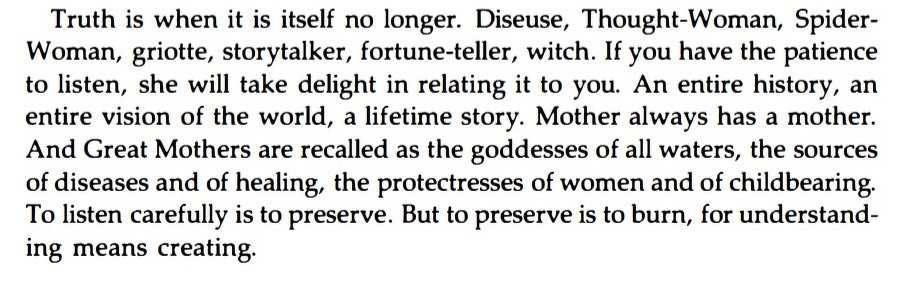
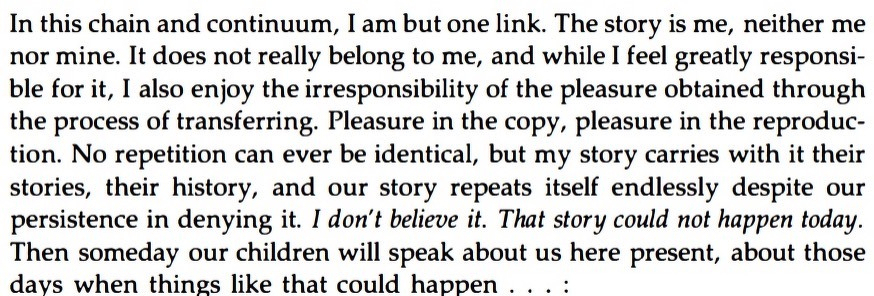
In this chain and continuum, I am but one link. The story is me, neither me nor mine. It does not really belong to me, and while I feel greatly responsible for it, I also enjoy the irresponsibility of the pleasure obtained through the process of transferring.
trinh t. minh-ha, “grandma’s story,” in woman, native, other: writing postcoloniality and feminism (indiana university press, 1989)
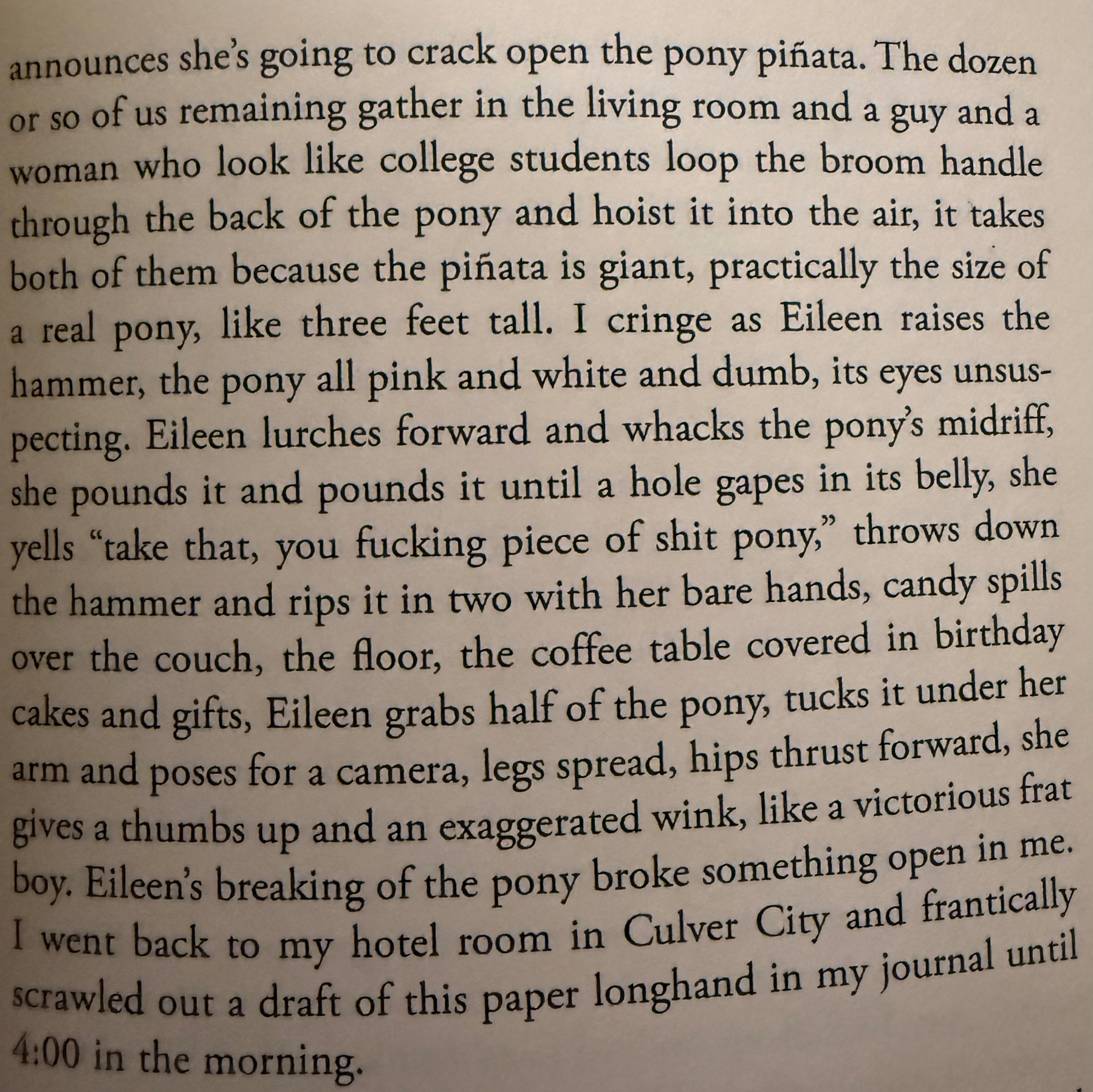
« Eileen’s breaking of the pony broke something open in me. »
dodie bellamy, “barf manifesto,” in when the sick rule the world (semiotext(e), 2015)
r.o.c. #11
	In the cinema
                	behind the screen, as if the screen

                                                	gave things its
colour.

	If all                      became whitish the picture would lose more
and more depth.

            	look at a landscape and screw up your
                                                    	character


                                                            	do
it when 	not thinking about transparence

        	the fact that we use certain words such as
"saturated", "muddy", etc. is a psychological
            	distinction

	             connected with the fact that            gradually eliminates
all contrasts

	One and the same                                 a different character in
the minor than in the major,              completely wrong to speak of
the character of the minor

                            	it is worthless and of no use whatso-
ever for the understanding                      	the characteristics
of the individual               When we do it, we are really only thinking
of special uses.                        	a tablecloth,

    	A luminous body

                    	a grey-hot

        	indication         something luminous and colourless
            called "white";                                                         our concept
of white

	A weak

        	sky which illumines
                    	merely by its appearance
            	roughly: something                          	in
a particular


                            	Gestalt

                           	impression

                                    	of a 'black-red

    	ghost
	weak whitish

                    	peaks of
reality.

        	the colour of the ghost is that which I

                      	experienced with

'right lighting' of         	semi-darkness.

                	a 'black mirror'.           	it darkens,
of course but it doesn't                        	'smirch'.

                	drowned in the

                                                    	appear-
ance of a surface

                                                	high-light on
silver,

                	child                   	pointing to
flames, or                          	the peculiarity of

                                                        	difference

	Milk is not
         	a concept  	only    	a
              	concept related to
parent things
serrulata spontanea
the blossoms called me out tonight while weeping by the reservoir and posing over and onto its still water. with a gentle clatter they prune back their wandering, cresting on the cymbaled turbulence from the chill. they step falteringly on the tooth of each wavelet. the petals are sitting wrong in the charcoal. the old lombardy poplar is busy whispering for me to come pay my respects, goading me for my inability to sketch the blossoms from memory. the shapes evade me, as if they were sawn away, carelessly, by someone who thought there might be more important things to remember. i watch another blossom skitter down onto the reservoir, a breathless, quiet sob echoing off the rocky rim of the reservoir’s mouth.
my throat burns. not because fire season was rough; my lungs suffered then—and now, still—but my larynx saved itself. no, this time around, my throat is scorched from sesquiterpenes in the tea, gently offset by the milk and sugar. each cup teethes through the slow banalities and anguishes of the days interrupting my ability to draw every last detail. i can feel the trail of embers all the way into my sinuses. the smell of the tea and the blossoms collapses into one smell, one memory, barely differentiable from the rest. the tea grows colder in my hands as the sun continues reclining into the horizon. i consider that i might be too close to tend to all the details properly.
i decide to cut myself out of the city at night and i find my way to get on the next departure with only minutes to spare. from the window next to my seat i can look up at the top of the hill and see the reservoir. the blossoms are too far to make heads or tails of beyond their candycane masses of rosy pale. i take the last sip of my tea as i feel the doors close and the wheels shudder into motion. dusk settles onto the shoulders of the city as we accelerate into the darkness. the conductor punches my ticket as the last of the daylight lapses into rest. before i know it, we’re a few miles past city limits. my sketchbook opens itself to a blank page, and i sketch pages and pages of blossoms from memory, shading each with care, until the tortillon disintegrates into my hands.
🍿 his smell (dir. kalil haddad, 2024)
the physical odour and the metaphysical reality are symbolically reciprocal…smells are often evaluated, therefore, by the positive or negative value of the remembered context.
— anthony synott, “a sociology of smell”, can. rev. of soc. & anth., 1991
a reversed summer, take 2
recorded 2021-2022 at bnsf havre yard, havre, montana; edgewater, chicago, illinois; brighton, seattle, washington
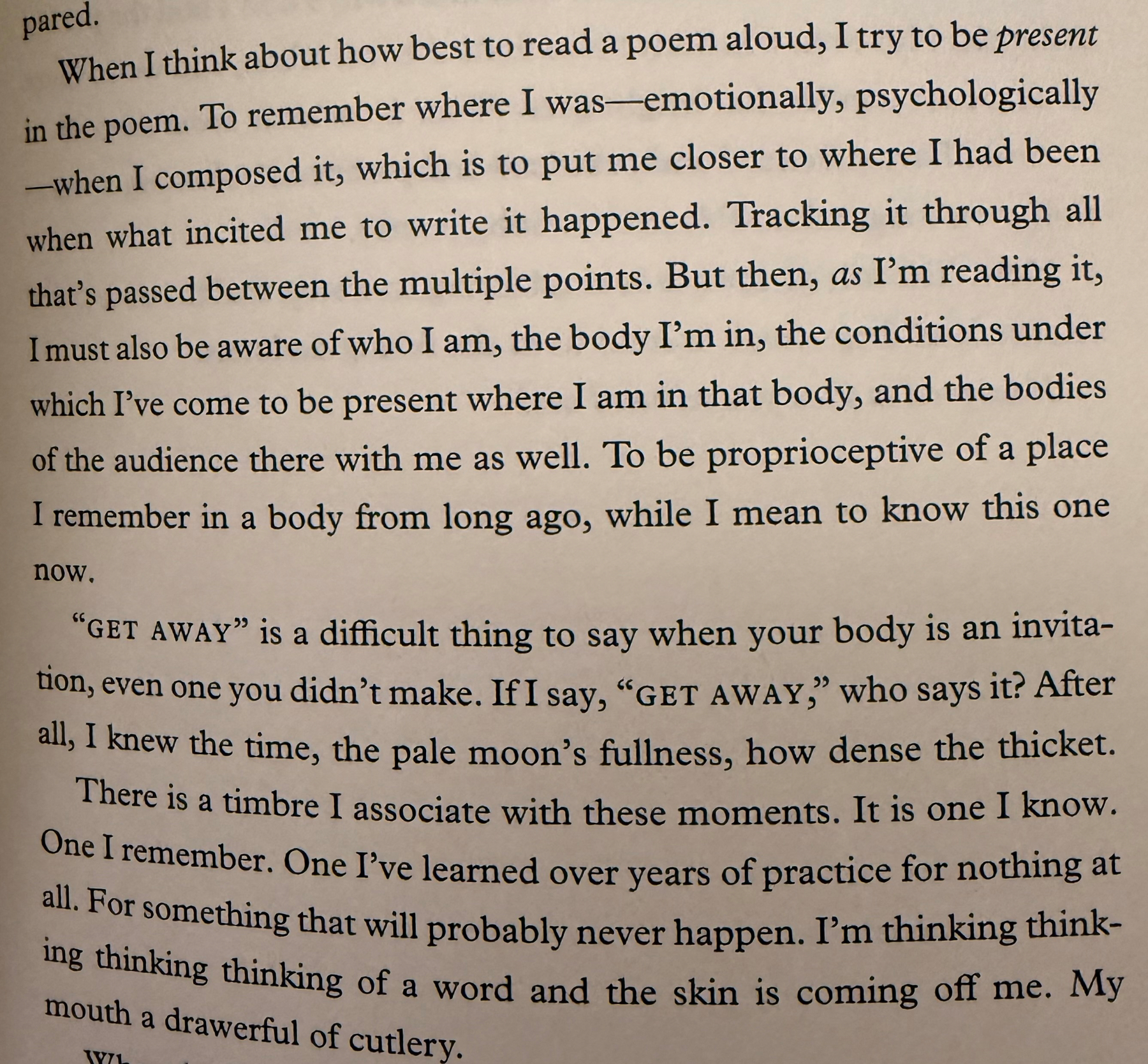
« “GET AWAY” is a difficult thing to say when your body is an invitation, even one you didn’t make. If I say, “GET AWAY,” who says it? After all, I knew the time, the pale moon’s fullness, how dense the thicket. »
📚douglas kearney, optic subwoof (wave books, 2022)
🍿 werckmeister harmonies, (dir. béla tarr, 2000)
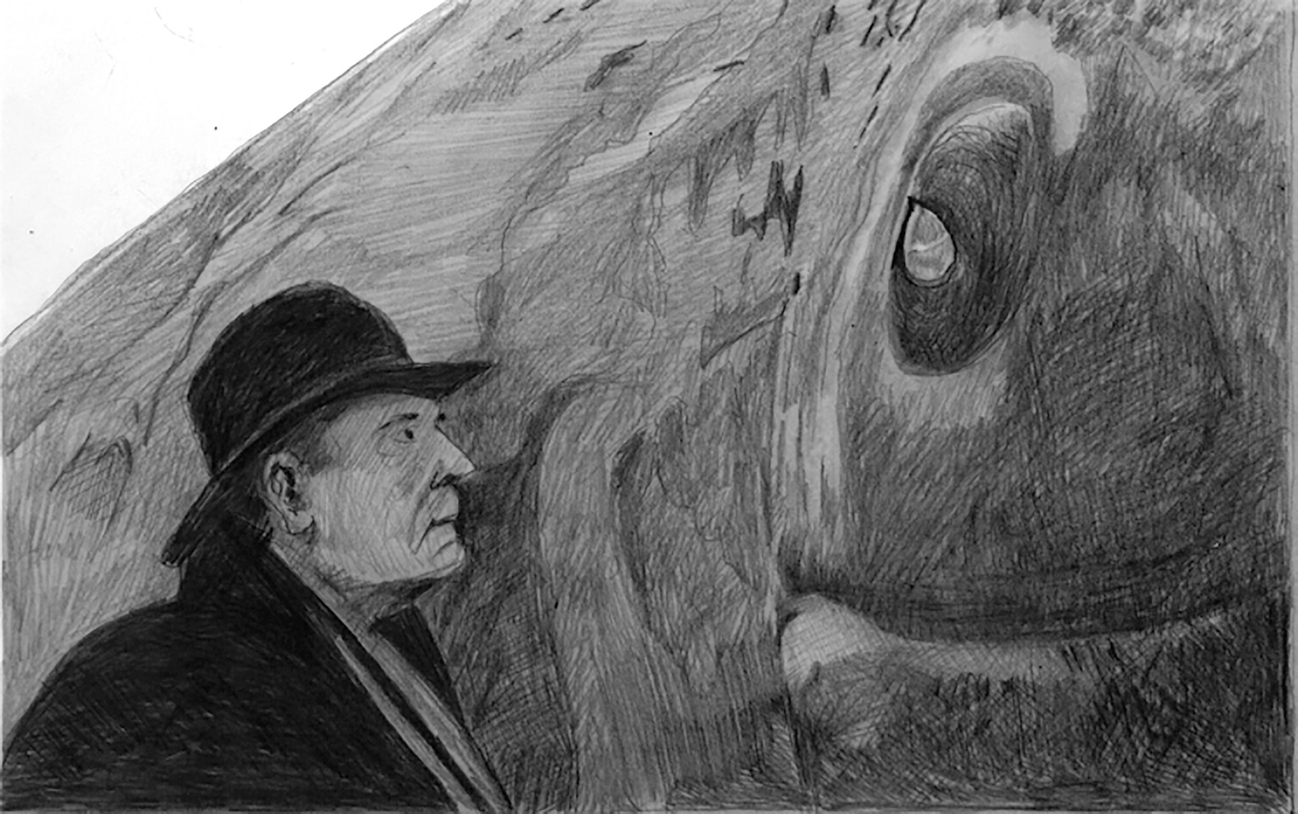
the whale itself was constantly remediated…transformed through death and putrefaction and also through various attempts at arresting putrefaction through freezing, chemical treatment, and taxidermy.
jamie l. jones, “fish out of water: the ‘prince of whales’ sideshow and the environmental humanities”, configurations 25(2) (2017). https://dx.doi.org/10.1353/con.2017.0012
![The media infrastructure approach is especially resonant in the case of the Prince of Whales, whose message was inseparable from its materiality, and whose means of transmission was a continent-wide assemblage of trains, railroads, and human and animal labor teams.&10;And, as the foregoing narrative demonstrates, the whale itself was constantly remediated: the whale was transformed through death and putrefaction and also through Newton and Engelhardt's various attempts at arresting putrefaction through freezing, chemical treat-ment, and taxidermy. Jay David Bolter and Richard Grusin theorized remediation as a way of understanding new digital media, but their ideas enable new understandings of the whale show as well.[48] Bolter](https://cdn.uploads.micro.blog/304411/2026/screenshot-2026-03-15-at-16.22.11.png)
the loss of my sinister
we make hay out of the light inside the cabin: reedy, aching culms of chartreuse rattling sympathetically with each bump and wending in the rails. my limbs on the left have gone awol again in a frustratingly and overly familiar loss of my sinister. this time, they have vanished from sight and are not merely non-responsive. i can’t see my wrist and knuckles despite the searing and swelling that renders them useless. the crystals lining the tunnel shimmer back through the window onto your tunic and catch in your necklace. a few beams find their way across your skin and mine, making nests and warrens along the way. they tickle my cheekbones and the bridge of my nose and you expectantly wait to see if a sneeze will be coaxed out of me.
that we are on this journey is nothing short of a miracle given my loss of the sinister becoming unremitting. last month i nearly sacrificed all my belongings as i ran through another station much like the one we departed from. i lost my footing on the cool marble of the staircase, fell forward, and my bag fell from my shoulder, over the balustrade, splitting open when it landed on the floor below. the clatter of nutshells reflected off the ground and the windows as they spilled forth through the threadbare duckcloth. all the other itinerants making their way to the trains below us circled their wagons of empathy. some travelers avoided any proximity, but those who didn’t remained unaware of the nutshells that split and crepitated under their feet.
you gaze along the edge of my eyelids as if to read me from the outside in. after averting my eyes, i glance back through despondent breaths. the last time i saw you was before the loss of my sinister, when you let me know how my left side was my best side. well before the words had even reached my ears i knew your fondness for that hand and wrist, watching it become swallowed by the depths of any vessel it found its way inside. my grief crackles off my lashes through the cabin and you hear my loss reeling out of me. you shift in your seat, searching for something without looking or using your hands. the corners of your eyes contract as we stay silent. i close my eyes as the hospitality of sunlight spreads across the back of my neck. as we drift into the countryside, i feel you grab and envelop my left hand. i wonder if i’m dreaming as the servos in my wrist and elbow whirr into position.
« is there a possibility that laundry can be redeemed as an art, a cultural form? if there is an aesthetic of cookery, can there be an aesthetic of the care and cleaning of clothing! »
aritha van herk, “invisibled laundry,” signs 27(3), 2002
![Laundry persists as a metaphor for secrets, and tied to its degenerate reputation is laundry's implicit association with the erotic. Of course, because laundry deals with the most private and suggestive articles of apparel, it rubs elbows with fetishism. Further, the physical situation of women washing has traditionally been seen as a site of opportunity (Odys-seus again!): "Wherever women were found in isolation, there was the potential for rendezvous. Throughout history, the place where laundry gets done-be it by the creek or in a freestanding shed-has been the province of a courtship" (Busch 1999, 62). And so, doing the laundry came to be associated with sexual experimentation and freedom. "Typical meeting places for women alone, like public laundries and spinning rooms, were feared to give rise to slander and intrigue and secret liaisons" (Warner 1994, 35). In the laundry, stories were produced and reproduced. This space, then, can be read as imaginatively dangerous, breeding a miasma of fictional and sexual exhalations. In contemporary terms, too, the laundromat (Margaret Atwood's novel The Edible Woman [1969], the film My Beautiful Laudrette [1985]) becomes a safe place for cruising: "just by glancing at a woman's wash, [a man] could discern the relevant facts of her life" (Busch 1999, 63).](https://cdn.uploads.micro.blog/304411/2026/2fdba8e510.jpg)
🍿 numbskull revolution (dir. jon moritsugu, 2026)

dude, trust me. let’s get skullfucked now.
conceptual art: continuum from genius to bullshit. where it lands depends on the state of the artist. DV with lofi greenscreen lands this squarely in “hyperpop cinema.”
🍿 late spring (dir. yasujirō ozu, 1949)
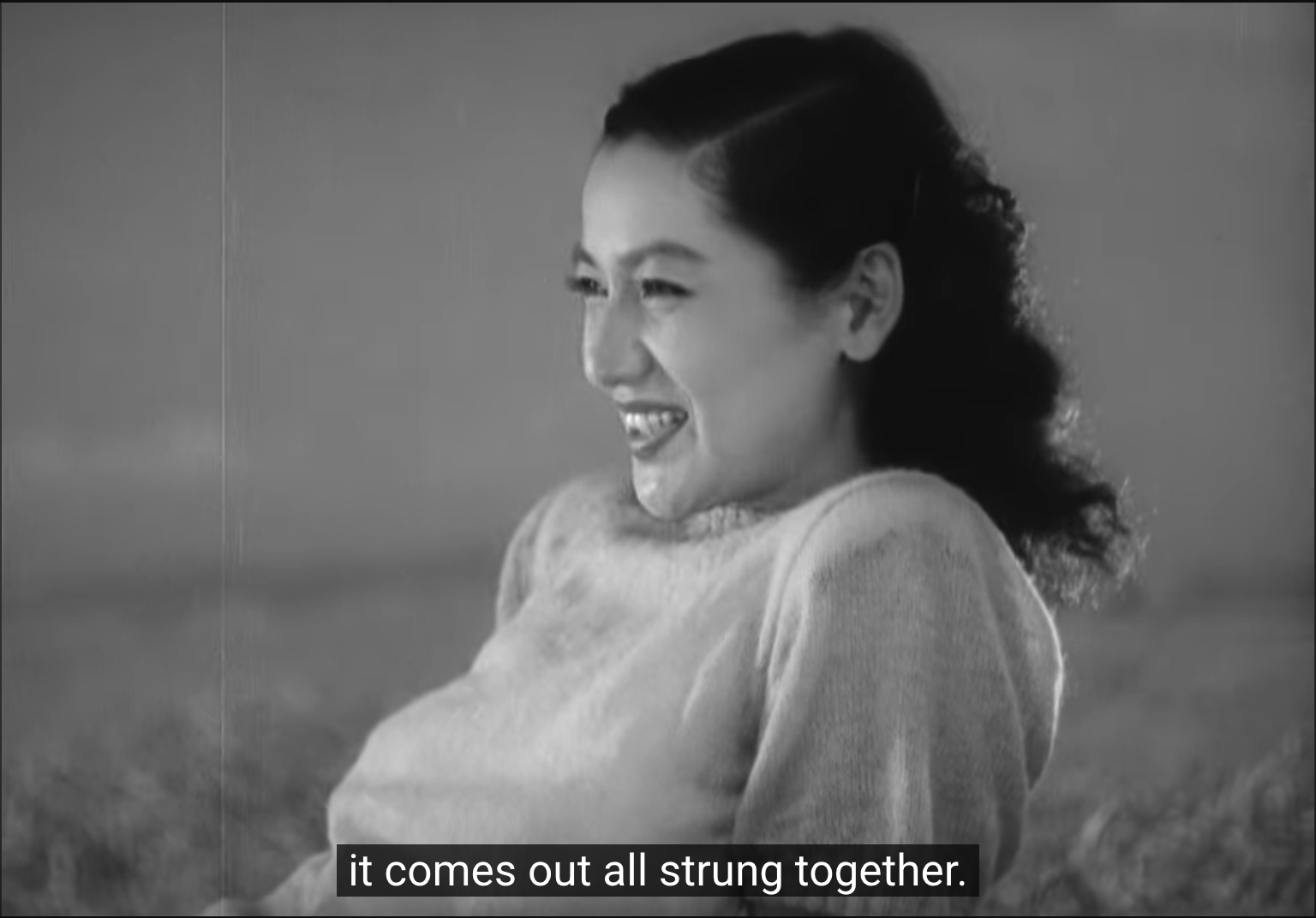
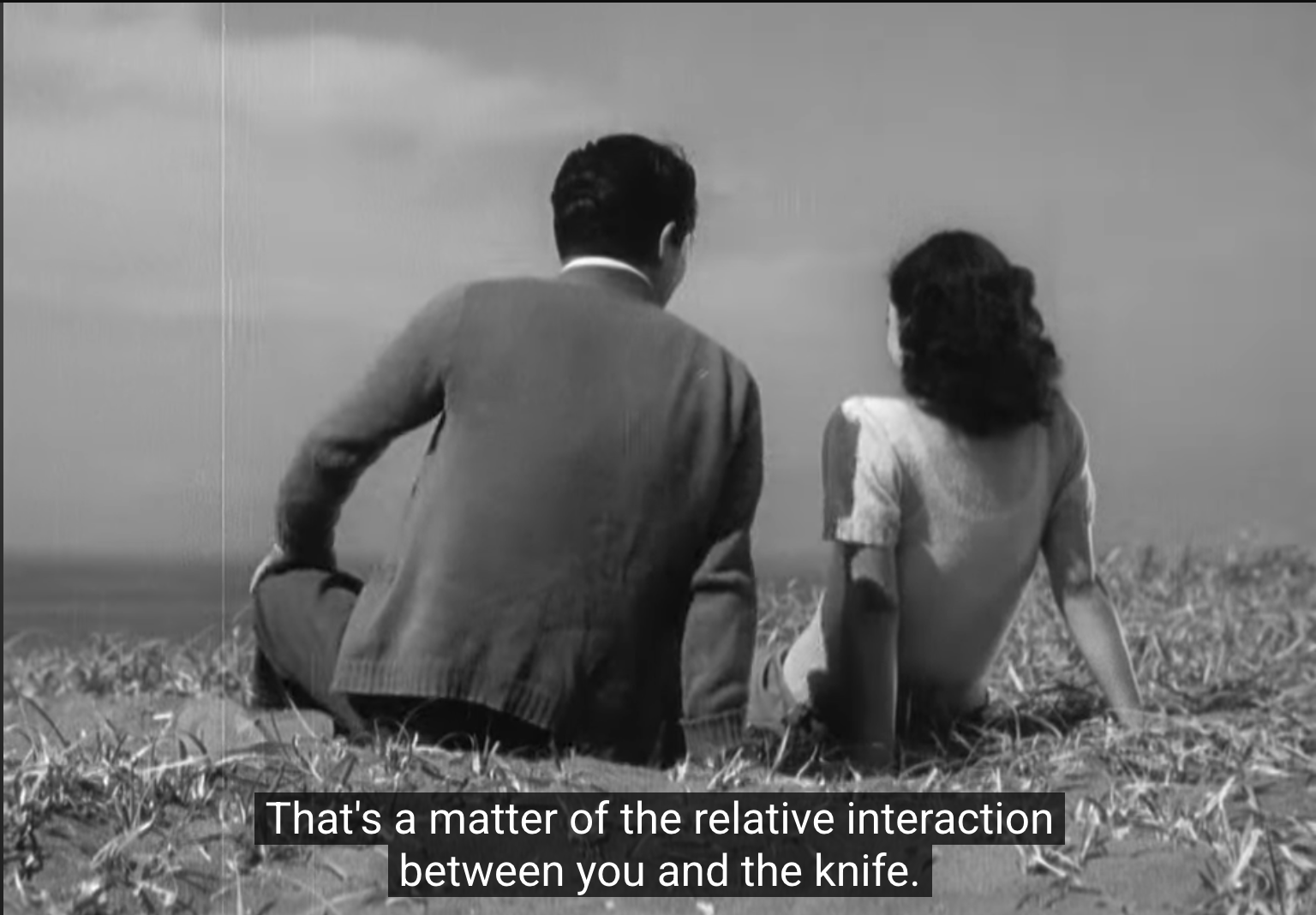
![a still from ozu's "late spring" of noriko (setsuko hara) at the beach with hattori (jun usami; off-screen), where noriko is smiling and is saying "[as the saying goes,] when i sliced pickled radish ..."](https://cdn.uploads.micro.blog/304411/2026/screenshot-2026-03-12-at-13.25.55.png)