
journal
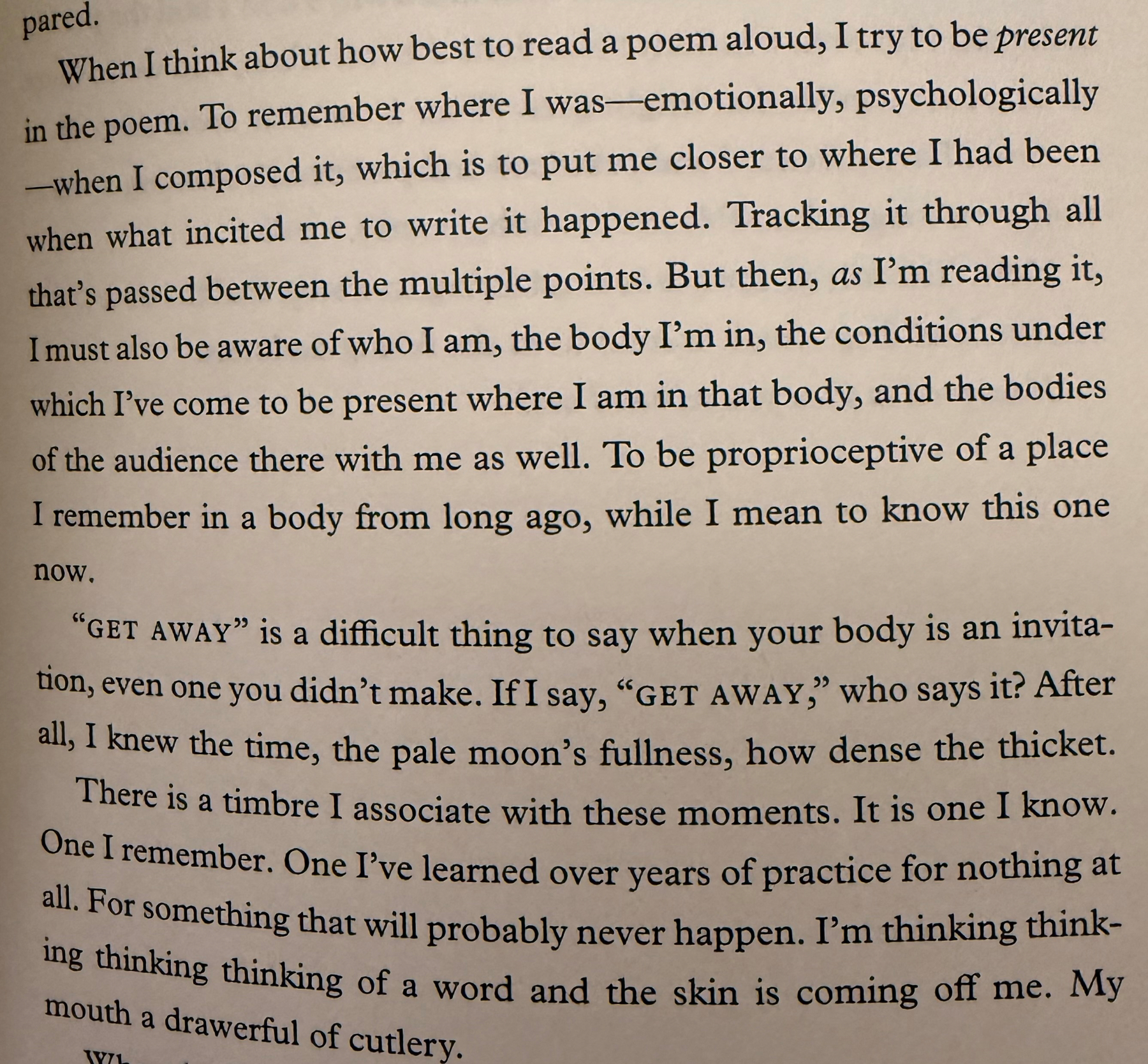
« “GET AWAY” is a difficult thing to say when your body is an invitation, even one you didn’t make. If I say, “GET AWAY,” who says it? After all, I knew the time, the pale moon’s fullness, how dense the thicket. »
📚douglas kearney, optic subwoof (wave books, 2022)
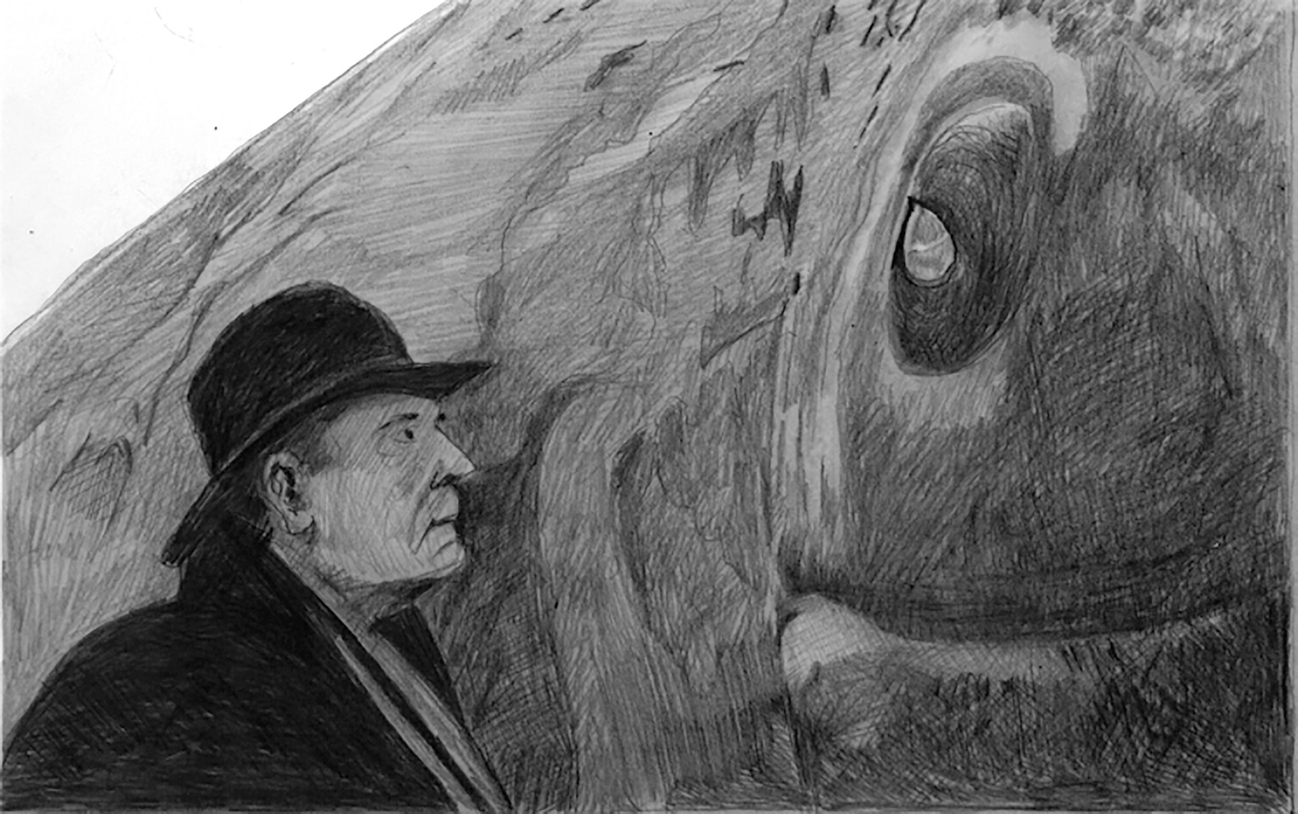
🍿 werckmeister harmonies, (dir. béla tarr, 2000)
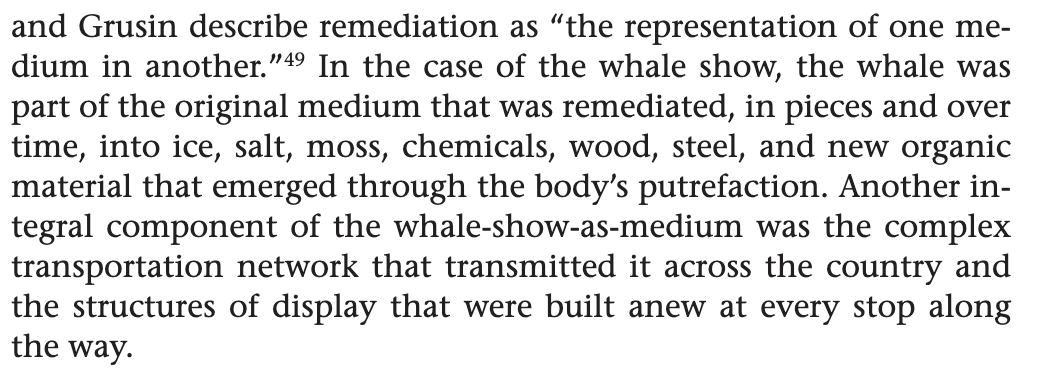
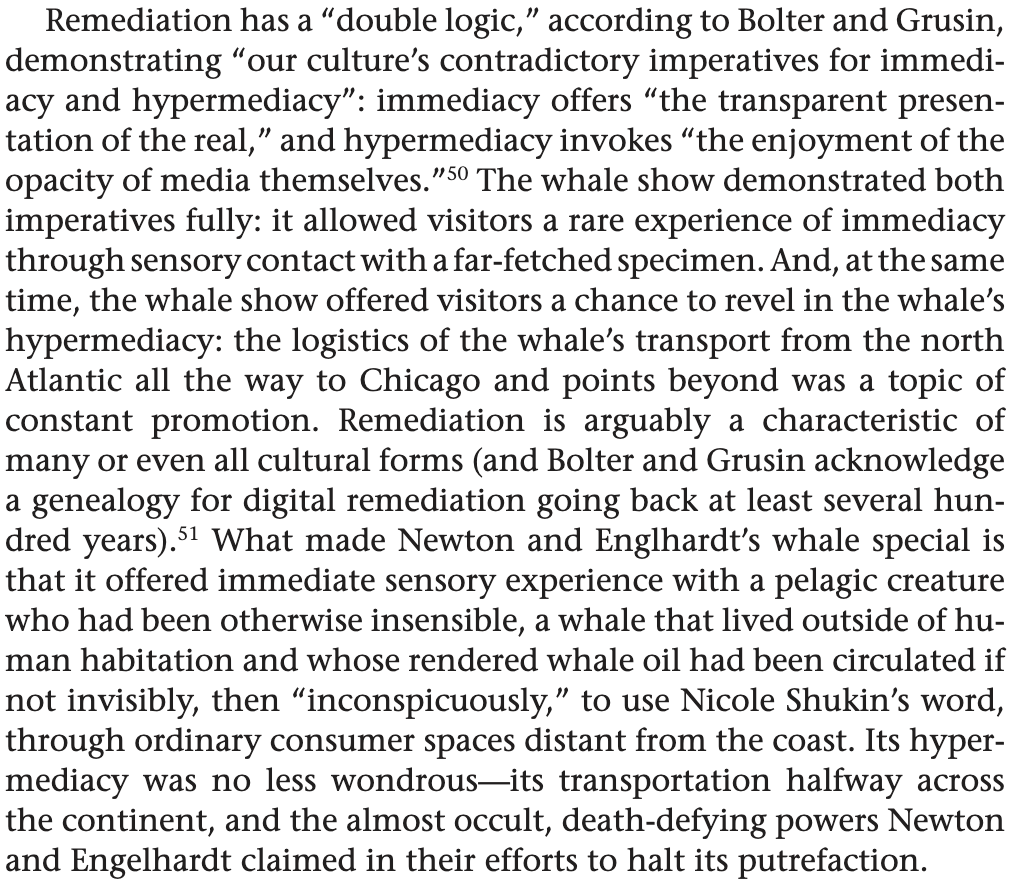
the whale itself was constantly remediated…transformed through death and putrefaction and also through various attempts at arresting putrefaction through freezing, chemical treatment, and taxidermy.
jamie l. jones, “fish out of water: the ‘prince of whales’ sideshow and the environmental humanities”, configurations 25(2) (2017). https://dx.doi.org/10.1353/con.2017.0012
![The media infrastructure approach is especially resonant in the case of the Prince of Whales, whose message was inseparable from its materiality, and whose means of transmission was a continent-wide assemblage of trains, railroads, and human and animal labor teams.&10;And, as the foregoing narrative demonstrates, the whale itself was constantly remediated: the whale was transformed through death and putrefaction and also through Newton and Engelhardt's various attempts at arresting putrefaction through freezing, chemical treat-ment, and taxidermy. Jay David Bolter and Richard Grusin theorized remediation as a way of understanding new digital media, but their ideas enable new understandings of the whale show as well.[48] Bolter](https://cdn.uploads.micro.blog/304411/2026/screenshot-2026-03-15-at-16.22.11.png)
🍿 numbskull revolution (dir. jon moritsugu, 2026)

dude, trust me. let’s get skullfucked now.
conceptual art: continuum from genius to bullshit. where it lands depends on the state of the artist. DV with lofi greenscreen lands this squarely in “hyperpop cinema.”
time is nothing but not amenable
our courting, like many a queer courtship, was undergirded by poetry. there was a moment of reading a poem while she was in the backseat of a car before we parted ways for a few days. after we started seeing each other, we would exchange texts in the days before we had established a label for one another, or even a regular and predictable rhythm, containing link after link. i like to tell myself that this is how it began: my fingertips deep in the words of elizabeth bishop, reading poem after poem about tending. these fingertips could not be on — or in — her. tap, tap, tap. cut. paste. send. it happened that one such poem by bishop was “the shampoo”:
The still explosions on the rocks,
the lichens, grow
by spreading, gray, concentric shocks.
They have arranged
to meet the rings around the moon, although
within our memories they have not changed.And since the heavens will attend
as long on us,
you’ve been, dear friend,
precipitate and pragmatical;
and look what happens. For Time is
nothing if not amenable.The shooting stars in your black hair
in bright formation
are flocking where,
so straight, so soon?
– Come, let me wash it in this big tin basin,
battered and shiny like the moon.
stephanie burt notes that bishop wrote this poem as a love poem for lota de macedo soares, her partner during most of her time living in brazil. arguing that bishop is breaking with he tradition of love poems given that “she writes of the ongoing, the potentially sustainable.” rather than it being a heroic, romantic, or erotic spike, burt continues:
[Bishop’s] emotional exertions are not revolutionary efforts or capital outlays but operating expenses, to be kept up as long as a structure stands. Lovers in “The Shampoo” wash each other’s hair not only once but regularly, once a month when the moon is full. (139)
somehow, this caught both of our eyes. before i could fully digest what we were doing, i had a calendar appointment on the next full moon. she told me she was going to wash and braid my hair. i felt my body quiver. it’s become a ritual in its own right since then, and something i hold dear, and protect. either i go to her apartment, or she comes to mine. sometimes, in special enough moments, she will prepare a meal for me as well.
on the last full moon, we began by eating the dinner she prepared for us: gluten free tagliatelle and tomato sauce with meatballs. after, she drew me a hot bath. after i eased myself in, she began washing my hair slowly, gently, patiently. the shampoo she used brought a bright tingle to my scalp. as i felt her fingers massage my head and move through strand after strand, i let go, breaking down into a heavy, halting sob. my strength did not matter for a change. i did not need to be a calming and powerful presence. just the same, the tears returned when she braided my hair. i felt safe from the insistent tugging she undertook. moreover, i was given high praise for my beauty.
she, too, earned something special as a reward for undertaking a rather obnoxious task she’d been avoiding. we’d decided on an impact session in advance. at her request, i brought a specific, albeit utilitarian, implement along with me. we re-established our guidelines and began with calibration strokes. each moment i raised my arm to deliver a blow, a deep calm pervaded my muscles. i watched her writhe beneath me when the strokes landed and felt peace and satisfaction. at some point, she asked for me to exert more control over her orgasm, using impact as both the proverbial carrot and stick. when she finally came, she, too, settled into a deep release of tears and emotion. i held her close and touched her hair, telling her how proud of her i was and how happy she made me.
since this last full moon, i haven’t been able to stop thinking about the gentle unmooring from reality that occurred. time had stopped for both of us at the beginning of the evening, and it allowed us, on some levels, to simply be present with one another, and to tend to each other in beautiful yet irregular ways. again, i thought of elizabeth bishop and lota de macedo soares, washing each other’s hair. stephanie burt describes this mutual tending-to as a form of “transitive attention” (as described by lucy alford) that existed in spite of soares' professional obligations:
This kind of attention might situate Bishop and her lovers (perhaps not only Soares) in a kind of queer time, characterized by a struggle to keep going, to support lovers and allies against the demands for production, expansion, new relationships, and roles defined by cishet stereotypes. This kind of lesbian time is about upkeep and mutual support, even a characteristically lesbian vision of homeostatic (balanced but changing) community upkeep. (140-141)
through our evening, through our ritual, we mark time differently and lovingly. we keep the tending and sustaining predictable yet allow ourselves to exist in a space where the clock can otherwise fade away. this gives us the space we need to show up to care for one another, and for the rest of the world. it is not just this tending-to that is the ritual: for it to be complete, we also the need the switch to happen. power must be exchanged, permission must be granted. through this, we are tempering a structure itself built and maintaned by these processes of co-creation. time is nothing if not amenable.
sisterhood/recordhood
the archive: if we want to know what that will have meant, we will only know in times to come. perhaps. (derrida, archive fever, p. 36)
the reason why i have a lease on life is because of my sisters, who saw me stand tall, who saw me crumple. the dedication to i have to the order is the thing that gives me purpose, that which puts me closer to heaven. the purpose of the order is discipline, faith, and service. by applying my skills to this purpose, i too become a disciplined and faithful sister. by serving as a disciplined and faithful sister, we maintain the order. to maintain the order is to maintain discipline. to maintain the order is to serve. to serve is to find in oneself the records that maintain the order, and the ones that maintain your purpose. trusting in the records is an act of faith.
with no possible response, be it spectral or not, short of or beyond a suppression, on the other edge of repression, originary or secondary, without a name, without the least symptom, and without even an ash. (derrida, archive fever, p. 101)
truth is relative in our order which spans many possible worlds. saying that our records are “true” depends on context. without context there is no convent. without the convent, the sisters cease to exist. without the sisters, there is no order, too. through this act of faith, i maintain the records for and of the sisters. these records take many forms: sound, text, bodies, objects, film, substances, scents, sensations, memories, fantasies, doubts, fears, demands, refusals, offers, offers withdrawn, and ceaseless lacunae. the record of nothing is still a record. the order and the record exist as an invitation. to invite a sister in is to bring her a record. to accept the invitation means that the sister becomes a record herself. to find a sister in the records is to welcome her back. to welcome her back is to transcribe her knowledge as a new record. to invite her in and to welcome her back is to feed, clothe, nourish and transform her. to transform her is to strengthen the order. to transform her is to strengthen her faith.
the /trouble d’archive/ stems from a /mal d’archive/. we are /en mal d’archive/: in need of archives. … no desire, no passion, no drive, no compulsion, indeed no repetition compulsion, no “/mal-de/” can arise for a person who is not already, in one way or another, /en mal d’archive/. (derrida, archive fever, p. 91)
the sisters keep saying: it is impossible to know everything, but it is not impossible to keep it. our order keeps everything, balances everything, records everything. the future of our order opens out of its records. the future of our order opens our sisters and opens out of our sisters. the future of the sisters is the future of our records.
the affirmation of the future /to come/: this is not a positive thesis. it, is nothing other than the affirmation itself, the “yes,” insofar as it is the condition of all promises or of all hope, of all awaiting, of all performativity, of all opening toward the future, whatever it may be, for science or for religion. (derrida, *archive fever, p. 68)
inspiration
- jacques derrida, archive fever: a freudian impression. chicago: chicago up, 1996.
- cinema crazed: “geographies of public sex [la&m film fetish forum]"
- olivia newsom, amalia v, mj tom, and mel leverich. “let’s talk about sex: sex, sexuality, sex work, and ethics in the archives.” session 201. society of american archivists annual meeting, august 15, 2024.
- matthew 25 (the parable of the ten virgins/the sheep and the goats)
- “spirit and the flesh” (section). leatherfolk: radical sex, people, politics, and practice. boston: alyson publications, 1992.
- the sisters of perpetual indulgence, “become a nun”
- “bloodsisters” (1995, dir. michelle handleman)
- the holy rule of st. benedict
- michael arditti, easter. london: arcadia, 2001.
- tala brandeis, “dyke with a dick,” the second coming. los angeles: alyson publications, 1996.
to m., m., m., t., a., a., l., and g. and all the trans leatherdyke sisters and siblings and cousins i haven’t had the opportunity to meet or play with yet.
basking in puce
polished metals and precious stones are so intrinsically transporting that even a victorian, even an art nouveau jewel is a thing of power. and when to this natural magic of glinting metal and self-luminous stone is added the other magic of noble forms and colours artfully blended, we find ourselves in the presence of a genuine talisman. (aldous huxley, “heaven and hell”)
amid a bit of uncertainty in my life i have been holding on to certain experiences tight as a way to savor them for longer than i’d be able to. perhaps i’d be better served by the ephemerality of some of these experiences, but i am entranced by the way they catch the light: they glimmer and fracture beams as a collection of prisms. i film these experiences in a way that feels timeless, or, more correctly, “out of time.” and perhaps it’s intentional, but these are exactly the experiences i chase, craving them both for novelty and timelessness as a kind of transcendence. maybe i can’t reproduce them, but i can try reproduce the feeling as a way to relish those memories - to make them out of time, out of place, and perhaps even positively anachronistic.
the latest instance of this was having an extremely extravagant fine dining experience earlier this week for my birthday. i was accompanied by someone for whom i have a great deal of affection. the restaurant itself is architecturally a crown jewel of northwestern 1950s modernism. as we sat in the lounge for a predinner beverage, my companion pointed out a gentle incongruity — the interiors felt different, very 1970s. i looked around as i sat on a banquette of dark puce velvet and noticed the fibers shimmering while we both mused about how we grew up in 1970s era houses. while nowhere near as fancy as where we found ourselves, we were warmed by the memories of lush carpet, exposed cedar beams, and river stone masonry work that helped rear us.
the rest of the dining experience was similarly timeless, with a stunning array of six courses that brought us to another plane of existence. the evening melted away while we took in beautiful views of water, trees, and bridges, and felt out of time. the light itself here was stunning: the approach of twilight, the boats and piers along the ship canal after night descended, and how each morsel on our plates, our place settings, and glassware winked us and seduced us into engagement. the first large course’s muted colors stuck out to me as well, as a small purse of cabbage and sablefish laid upon a puce-colored bed of mushroom and hazelnut puree. even departing the restaurant was an experience of light, with the muted glow of the the sign next to the entrance and valet carport beckoning us back as a slowly fading hearth might – possibly whispering a longing “don’t forget about us.” and really, how could i?
as i was lost in my thoughts yesterday, i remembered that some film makes me feel this way, and i remembered an eternal favorite: kenneth anger’s “puce moment." while only a mere six minutes, this was a film that i’ve clung to as if my life depended to it. i was in my early 20s when i watched yvonne marquis, anger’s seemingly timeless starlet, smile widely, flirt and envelop herself in sequins, apply perfume from an absurdly large emerald green bottle, lounge peacefully, and walk a pack of borzois. it was intoxicatingly out of time on its own: “a film that /feels/ like something from the 1960’s, produced in the late 1940’s, looking back to the 1920’s." as a mildly clueless college student it was exactly what i was looking for: the exotic without exoticizing, ecstatic in ways that i would be unable to describe for anyone else. i was being invited into a world i couldn’t have experienced otherwise without that invitation.
my inclination, as always, was to find more ways to cling to these puce moments: in writing and in a playlist. each is different, each intersect one another. the words recall how we can mark time through rhythm and serve to /refract/ the experience rather than reflect it. the playlist approaches this similarly. with these two things in mind i want to encourage us to open ourselves up for a litany of reasons. can we refract the feeling through sound? can we make things boundless enough so that we allow ourselves to become awash in the wonder of having an experience with someone where time itself becomes a fiction - where we bathe in huxley’s preternatural light to “evoke, from the boundless chaos of night, rich island universes … the glitter of metal and gems, [and] the sumptuous glow of velvets and brocades”? (huxley, again.) that, my friends, is where i cast my eyes - the place where i can weave everything together into an ecstatic celestial tapestry.
the not knowing: cage and calvinism
it’s been a while since i’ve been deeply unsettled by the lack of resolution in a film, especially if the film’s conceit is overall preposterous. however, having just experienced the disquieting jouissance of such cinematic bombast last night, here i am, with a need to verbalize and process this tormentand whom else would i have to thank for this but my favorite member of the coppola family, nicolas cage, rumplestiltskin of the dramatic arts that he is. what, then, of the film that originated this long-winded introduction of this disquiet from theological and epistemological perspectives? it would be none other than KNOWING (2009, dir. alex proyas). spoilers follow, so be forewarned, lest ye find not your salvation.
i will not go into the plot in depth, but rather obliquely and nonlinearly. as such, the remainder of my writing assumes familiarity with the movie, and i’ll say up front that i’m providing an unalloyed recommendation. if i were to sum it up, however, its major thematic aspects relate to knowledge, faith, other-worldly forces, and the epistemic uncertainty that undergirds all of them. i’m struck by the movie’s refusal to take a clear stance on its major plot points, and thus places responsibility on the viewer to bring its own interpretation to bear. even in moments of it being at its most clear-cut — namely, the penultimate scene of ἀποκάλυψις, a razing of new york city by fire caused by climate change^W^W “solar flares” (i.e. “the wrath of god [that] burns against them” a la jonathan edwards) — an engaged viewer will most notably exclaim “what the actual fuck?” despite this ambiguity, this film is masterfully unsubtle, teeming with intertextual references to christian eschatology across multiple denominations and media, an embarassing use of skepticism as a kind of morality strawman-cum-punching bag, and extremely intense depictions of plausible(!) real-world disasters with mildly sickening CGI.
in terms of its focus on free will, KNOWING initially opens with the conceit of nicolas cage as john koestler, an MIT astrophysicist holding court in an undergrad class opposing free will with some sort of in-between hybrid of nomological determinism and predeterminism. it is here that john, says that he thinks “shit just happens,” and soon after we discover that he’s an atheist academic raised as preacher’s kid that had his latest crisis of faith after his wife died in a horrible hotel fire just days before his birthday. as he becomes obsessed with decoding and identifies the “real life” past and impending catastrophes, we see him bias towards predeterminism, but the as the truth itself is slowly revealed we are supposed to infer that every known cataclysm is delineated as a warning that something is coming for “EE” — everyone else. (it’s giving “this place is a message and is part of a system of messages; pay attention to it.” real “pick me” vibes.) as john dives into to try to stop or save people from terrible things happening (literally sticking his hands in flames to no avail in a failed attempt to save a plane crash victim), he is reminded and humbled by the great futility of his own existence, and his powerlessness in a cruel universe. why are all these things happening? and why do we know the exact predicted death toll?
as we start to realize this, it’s here that i see that the film begins shifting from predeterminism to predestination, and that perhaps, someone in the film is a messenger who will receive this message from the far beyond. it’s clear that the movie’s precocious child characters – john’s son, caleb, and abby, the granddaughter of lucinda, the girl who wrote the numbers that went into the time capsule – are the recipients of the gift of prophecy. but surprise: they’re also special in that they are the elect, bound to bearing the life of the world to come and imminently transported away by these celestial beings. and yet, are they angels? are they aliens? are they both? where does that leave poor old john? fucked in the end: he is not one of the elect. faced with his own spiritual damnation and physical annihilation, he returns to his ancestral home to be with his mildly estranged parents and heavily queer-coded nurse sister.
what’s fascinating to me about this movie is that it refuses to come out and really say what it’s about, and here’s where i disagree with roger ebert. we are supposed to be unsure whether they’re angels or aliens because their depiction is ambiguous. what fascinates me is that the lead writer, ryne pearson, also deliberately plays at that ambiguity. just the same, cage also believes it’s up to the viewer what to take from the movie, and expects that it might stimulate discussion. compare donald barthelme:
this is, i think, the relation of art to world. i suggest that art is always a meditation upon external reality rather than a representation of external reality or a jackleg attempt to “be” external reality. (“not-knowing”)
pearson is apparently a dedicated Catholic, too. these aspects combined make it also all the more fascinating to me that the movie’s themes feel particularly Calvinist: despite our faith and good works, most of us are truly and undeniably bound to suffer. yet as john says goodbye to caleb, and both as foreshadowed by john’s phone conversation to tell his father that the end is nigh and in the koestler family barbecue^W incineration and damnation, there is a presumption of being ready for that next life and being sure that you’ll be reunited in the world to come based on faith – which in some senses is a /not-knowing/.
however, a good Calvinist epistemologist (yes, i’m side-eying Plantinga) might not say this, and may well lead us down a path of something like the presuppositional apologetics of cornelius van til. in these cases, the world of KNOWING seems to suggest that we need to accept that world’s God that makes it possible for an atheist like john to be so rationally minded in the beginning of the movie. john operates in the discursive frame of science and the academy and thus has to perform rationality to be credible. caleb is disappointed when he realizes (early in the movie) that john doesn’t believe in heaven. despite thinking that “shit just happens” and that “we can’t know for sure” (i.e., that heaven exists), at some point in the past john has accepted a presuppositional mindset, which he slowly regains as he sees the truths in the messages. he specifically notes that he lost a form of faith in knowing what was coming while in the throes of grief, which in turn led him to be more nomologically oriented. however, the list of numbers was an intervention that led him to reconsider his loss of faith, because despite how unlikely it might be to an extremely rational astrophysicist, he was called back to accept the presuppositions that inform all of his underlying complexities.
again, we need to remember this was most likely not intentionally a Calvinist apocalypse film. the statements of pearson and cage don’t jive with that. if anything, KNOWING indeed puts the onus on us to observe and dissect the discursive and epistemological frames we look through to square religion and the world. this is perhaps, indeed, why the movie is so baffling - that not even the angel/iens ever describe how or what ever directly to the audience. one cannot simply anticipate what will happen, and that in itself, leads to the revelatory experience of watching this film itself. without prior knowledge, without that grounding, you really have no fucking clue what you’re getting yourself into. with apologies to barthelme, this is:
the combinatorial agility of knowledge and belief, the exponential generation of meaning, once they’re allowed to go to bed together… (barthelme, “not-knowing”)
… the liaison where we can experience the epistemic jouissance of KNOWING.
in a stage whisper: silence, embodiment, and trans* archival praxis
inches give way to lies paint a target on your chest to make it easy for the hunters 🔗
a university librarian at an ivy league writes for an audience of historians about archival silences, and introduces the notion of a “shouty archive”. what? i mean, i suppose it’s an imperfect and relatively powerful metaphor, as the author herself notes, but i’m also not sure it’s really all that illuminating of a point. “archival silences” do exist, and have been widely theorized based informed by the work of michel-rolph trouillot.
i don’t find talking about absolutes all that satisfying. i’ve been thinking a lot lately about the moral claims around access to information and the subtleties that get bulldozed in the name of impossible perfection. archival discourse, like the piece i reference above, talks about correcting silences, and the work of verne harris introduced the notion of “archival whispers”, which trace around the absences and silences.
if the archive is a remnant, it is one that keeps whispering to me, insisting on its place in my everyday life. what i might have said [to an archivist friend] instead is this: “i am a disquieted archive that fumbles in words. a thing made up of infinite, intractiable traces.”
or, i might have simply said: “the archive is a stimulus between myself and myself.” (julietta singh, “no archive will restore you”)
silence, trace, and voice, and the intersection of those aspects as an expression of power by those represented in the records is an area ripe for further study. this is coming to mind more fully lately for a few reasons: 1) the concerns about access to information and the loss of control some of us feel, 2) how to reclaim power as trans folk, 3) what the state of the trans archive(s) to come will be, and 4) how i (or “some of us”) exist on ~gemini~~ as a parallel space.
given these aspects i feel as though it’s only natural to take a step back and think about in some cases why we want to be heard. i don’t feel as though i owe everyone — and, in actually, every trans person i know or meet as well — the dignity of a comprehensive narrative about my life. a presumption of access to that kind of detail, trauma, what have you has to be earned. but i might choose to hint at one thing or another as opposed to publicly posting transition photos online.
however, i do shitpost as much as i earnestpost, and shitposts are a way to make a murmur audible for the right audience. similarly, posting on gemini feels like a bit more of a sacred space in that i can be “freer”. even if i link to my ~gemlog~ micro.blog posts or other writing here, you really need to want to read it if $PLATFORM is not a major part of how you interact with information online. it passes under the radar enough that the average person won’t discover it. together, this it is a subtle form of refusal to be present, or simply be.
since the materiality of the body threatens to eclipse meaning, the voice is neither embodied nor disembodied but /negatively embodied/. that is, the body is incorporated in the voice as a /lack/. whispering, in refusing to surrender the absolute materiality of the body, stages the /lack of a lack/, thus concealing the body from the symbolic scheme. from extreme /intimacy/ to extreme /disembodiment/, whispering constantly oscillates between this pair of dialectic traits, whether in its physiological qualities or its cultural, social, and religious implications. (xinghua li, “whispering: the murmur of power in a lo-fi world”)
this kind of stage whisper, in an archival sense, is a symbolic retreat as a way to control that power. it is a refusal to be fully embodied, fully participatory, fully seeking validation. what i want to see, thus, is forms of trans* archival practice that engage with this: ceaselessly becoming a space for selective voice and register, for spectra of embodiment, for spectra of presence, abundance, and lack.
citation and/in context of gemini
tamsin recently wrote about her “ethically questionable citation practices” that she intends to apply on her gemini capsule. i think she is rightly conscious of citation practices being central to knowledge construction and conventions of expression, and how gemtext (and gemini itself) allow us to think differently. she notes that her style — in actuality, methods — will evolve, so my terse comments are really limited to the version as it existed on 2024-04-09.
we hear a lot about the “politics of citation” and “citation as a feminist act” through references like those she includes in her page. these discourses, at least in terms of my own experience of them, are typically situated in academic-professional contexts. while i’d argue that both tamsin and i are embedded and intimately familiar with these contexts (😏) my assumption she’s not attempting to have her writing on gemini within the discourse register of these contexts.
my take is her approach seems as though it glosses over the intent of certain kinds of citational practices in a wider variety of registers, in a space, as it were, for the dolls. at least in my own writing regardless of genre, citation and reference serve at least three major functions: 1) attribution, 2) aesthetic, 3) aide memoire. the motivations of these forms of citation and reference are arguably more important than the specific convention used to express them
attribution is the most obvious - it operates in the mode of academic-professional discourse, and is typically leveraged to construct and connect knowledge, to wash one’s hands of plagiarism, and for these grander political ends. i probably find it the least interesting of the three.
aesthetic is a fun one. in my view, aesthetic “citations” can often be anything but typical citations outside the context of a critical edition. they’re often oblique references - from time to time, they can also co-exist as attribution (see, for instance, the work of chaun webster). i use it in some of my own writing, too (like pulling a line from an oscar wilde work into a larger poem). it seems like at least some of tamsin’s intended uses of epigraphs serve this function.
aides-memoire in some cases may also serve as attribution if i’m trying to remember the provenance of the idea. at the same time, there may be cases where i’m actively trying to track my own (timebound) disagreement with a particular idea or argument - and as such, a citation alone would typically be accompanied by some sort of note documenting this.
this was all fairly rambling, but my intention was to help get tamsin think about the ways that she wants citations to /do/ things. (yeah, of course i’m going to bring it back to austin, butler, and derrida by way of hypertext theory. see nakassis and harpold maybe that’s what should inform the style guide - how does she recall the kinds of flourishes she took when she attempts to do something different with citation(s) on her gemini capsule?
peak performance
don’t stake too much in me don’t make me fall in love again we try this over you and falling over me into your bedroom stay for the afternoon and then go back to work and soon i’m coming home again coming home again
for all intents and purposes i am not what most people think of as an ideal trans woman. (sadly, this also includes a lot of other trans women.) my body is not small, but rather rugged and sturdy. i have a belly and tiny tits and a decent ass that gets increasingly peach-like over time. when i look at myself, though, i see myself as a beautiful creature. i think this started to happen alongside a significant decrease in dysphoria once i accepted that i might be a butch — the rara avis of gender presentation and identity. the butch i am is the person i longed to be, and i love this version of myself more and more.
i’d always looked up to butches when i was a younger, sexually confused inhabitant of the wrong body. this ranged from old school working class butches that i saw at my first gay bar that i’d go to with my high school ex, fancy academic butches (botanists! working artists! literature profs!) that i ran into throughout college and grad school, and the butchy campusdyke friends i ran with who really went out and made their own fashion sense rather than being hidebound (lol) by the motorcycle jacket-cum-501s look.
i guess it’s fairly similar to me that i made my own path. i guess i have my femme moments (says the girl who bought two dresses and a skirt last weekend), but i really gravitate to a soft butch. my butch is that of velvet and leather, of the scents of a barbershop, of boots and carabiners, of alpaca and teak. it’s not “gentleman butch,” as i am not a gentleman, nor trying to be one. for me, butchness is a form of service. it’s a butchness that smells of frankincense, cider, and soft cheese. it is the butchness of chivalry, albeit with better class politics: one of the old weapons from a more civilized age.
about four months ago i talked to my doctor about going on supplemental testosterone for “performance” reasons related to sexual function. (i also refer to this as “recreational T”, or “shits and giggles T”.) every few days, i slather a pump of 12.5 mg per pump gel to my inner thighs and hope and pray for the best. i’ll say that the experience has been marginally better, but it’s still unpredictable, even when supplemented by something banal like tadalafil (which, to my chagrin, my insurance considers 10 pills to be a 90 day supply).
given this unpredictability of my own sexual function, i logistically supplement my own body with a strap: a harness that looks and functions like a jockstrap, and a starry sapphire silicone dick. when i put it on last (before fucking a new lover), i caught a glance of myself in the mirror. in a moment like that i feel powerful, dramatic, and in control. i feel butch, but not masc. it becomes an extension of my beautiful, chunky body, “imperfect” in all the right places, a functional accessory much like my eyeglasses.
i catch more glances of myself as i ogle my changing body as i return from the gym. three months of weightlifting have led to amazing progress, and i move slowly, intentionally, as i struggle with the weight i take on. i watch videos of me deadlifting 200 lbs. and squatting 185 lbs. and i see a strong, powerful, beautiful butch woman. i look at my broad shoulders and back muscles and feel a longing for more definition — for more butchness as if the sweat that drains me carries it away from me. i look at my thighs, chiseled from three months of squats, and fall in love with myself again. i look at my face, and see the face of not only myself, but my mother. i look at my hands and i see calluses that will scrape across a femme’s thigh with the gentleness of a cherry blossom falling to the ground. as the meme goes, this is the ideal female body; you may not like it, but this is what peak performance looks like.