« “GET AWAY” is a difficult thing to say when your body is an invitation, even one you didn’t make. If I say, “GET AWAY,” who says it? After all, I knew the time, the pale moon’s fullness, how dense the thicket. »

📚douglas kearney, optic subwoof (wave books, 2022)
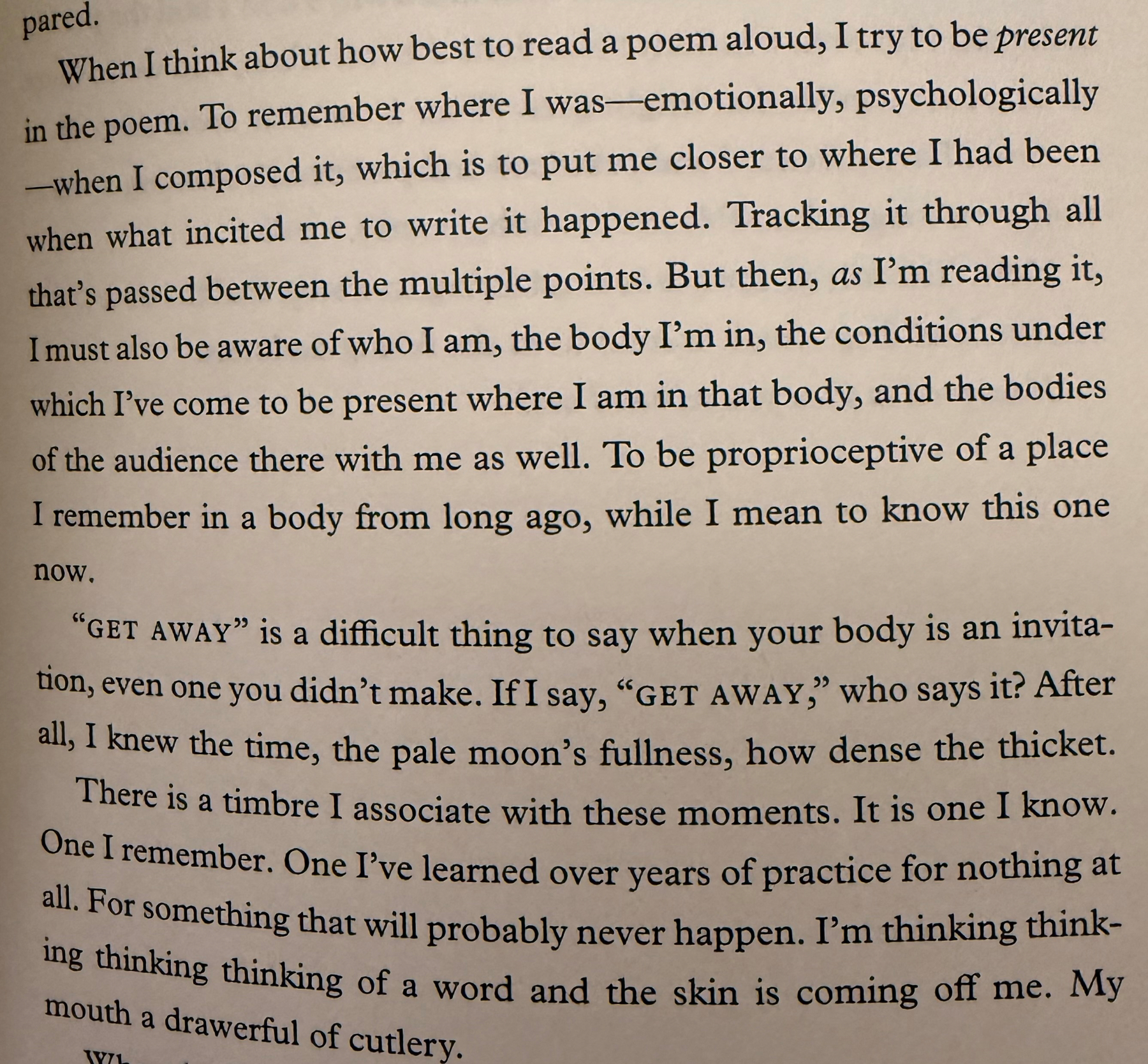
When I think about how best to read a poem aloud, I try to be present in the poem. To remember where I was emotionally, psychologically—when I composed it, which is to put me closer to where I had been when what incited me to write it happened. Tracking it through all that's passed between the multiple points. But then, as I'm reading it, I must also be aware of who I am, the body I'm in, the conditions under which I've come to be present where I am in that body, and the bodies of the audience there with me as well. To be proprioceptive of a place I remember in a body from long ago, while I mean to know this one now.&10;&10;"GET AWAY" is a difficult thing to say when your body is an invita-tion, even one you didn't make. If I say, "GET AWAY," who says it? After all, I knew the time, the pale moon's fullness, how dense the thicket.&10;&10;There is a timbre I associate with these moments. It is one I know. One I remember. One l've learned over years of practice for nothing at all. For something that will probably never happen. I'm thinking thinking thinking thinking of a word and the skin is coming off me. My mouth a drawerful of cutlery.