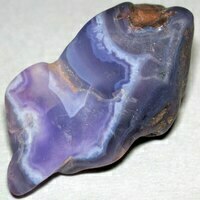
serrulata spontanea
the petals are sitting wrong in the charcoal. the old lombardy poplar is busy whispering for me to come pay my respects, goading me for my inability to sketch the blossoms from memory.
🍿 his smell (dir. kalil haddad, 2024)
the physical odour and the metaphysical reality are symbolically reciprocal…smells are often evaluated, therefore, by the positive or negative value of the remembered context.
— anthony synott, “a sociology of smell”, can. rev. of soc. & anth., 1991
a reversed summer, take 2
recorded 2021-2022 at bnsf havre yard, havre, montana; edgewater, chicago, illinois; brighton, seattle, washington
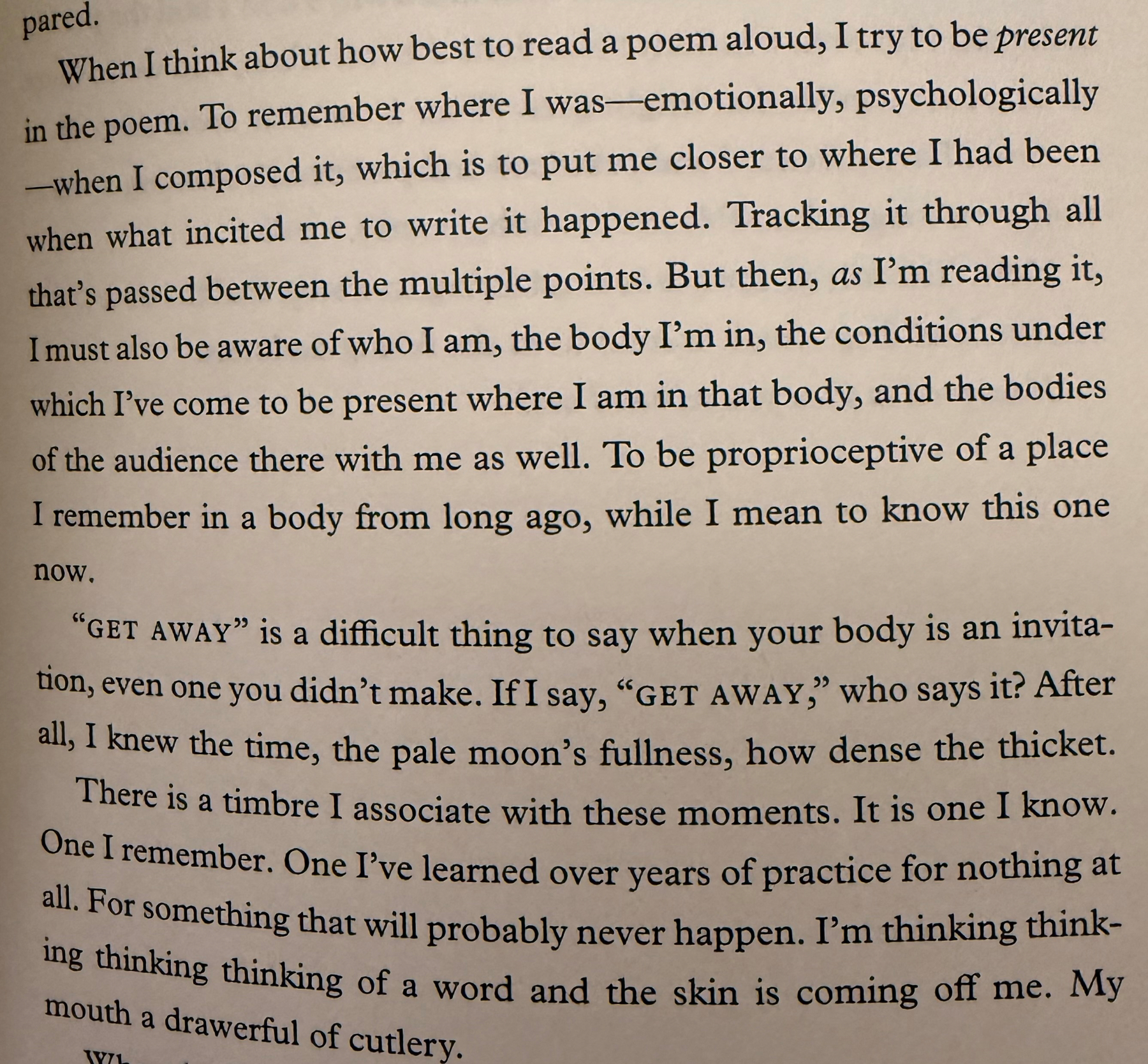
« “GET AWAY” is a difficult thing to say when your body is an invitation, even one you didn’t make. If I say, “GET AWAY,” who says it? After all, I knew the time, the pale moon’s fullness, how dense the thicket. »
📚douglas kearney, optic subwoof (wave books, 2022)
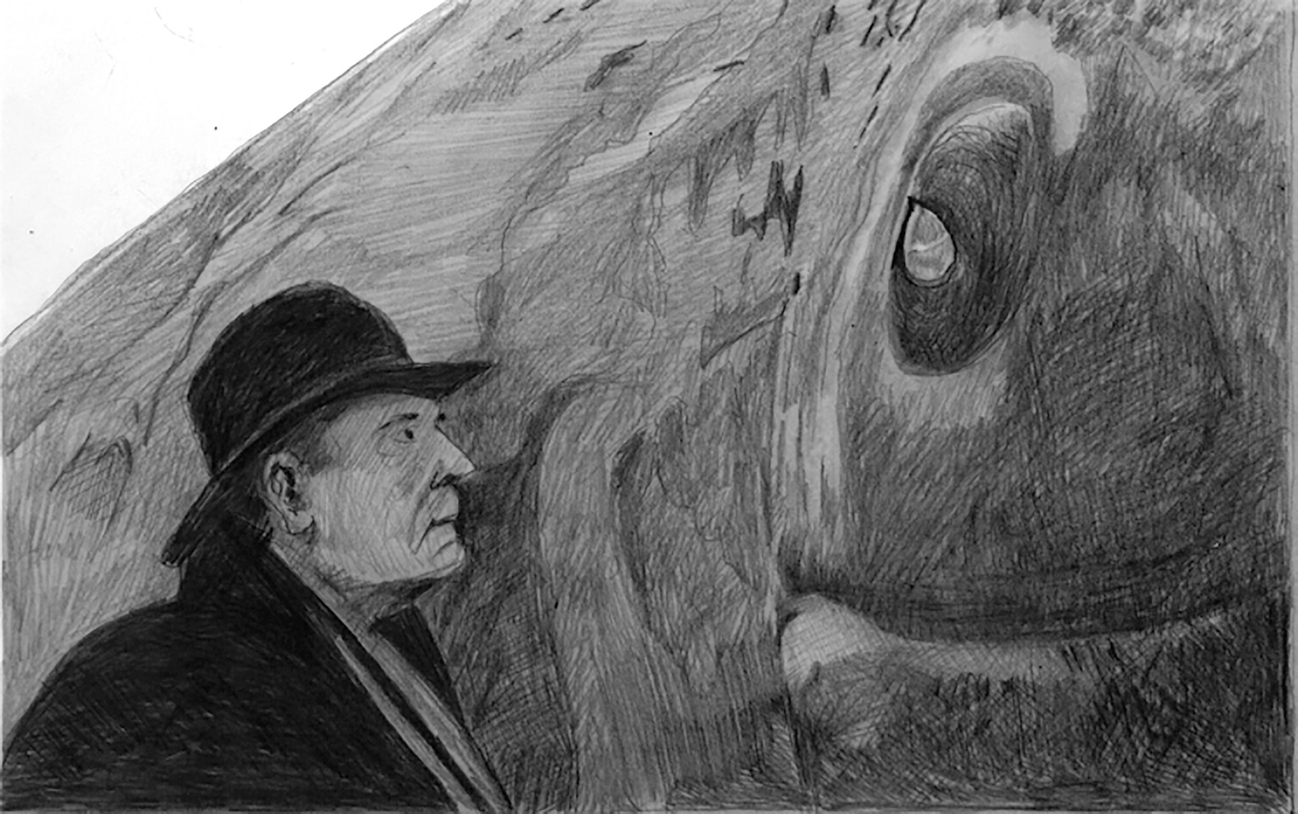
🍿 werckmeister harmonies, (dir. béla tarr, 2000)
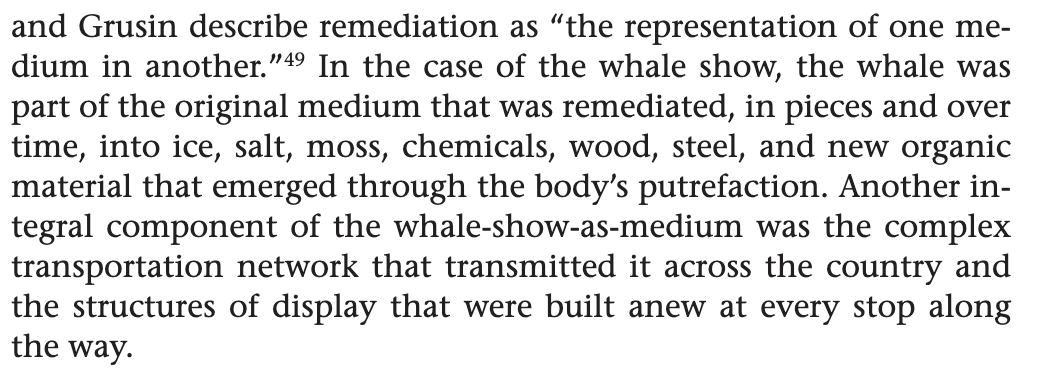
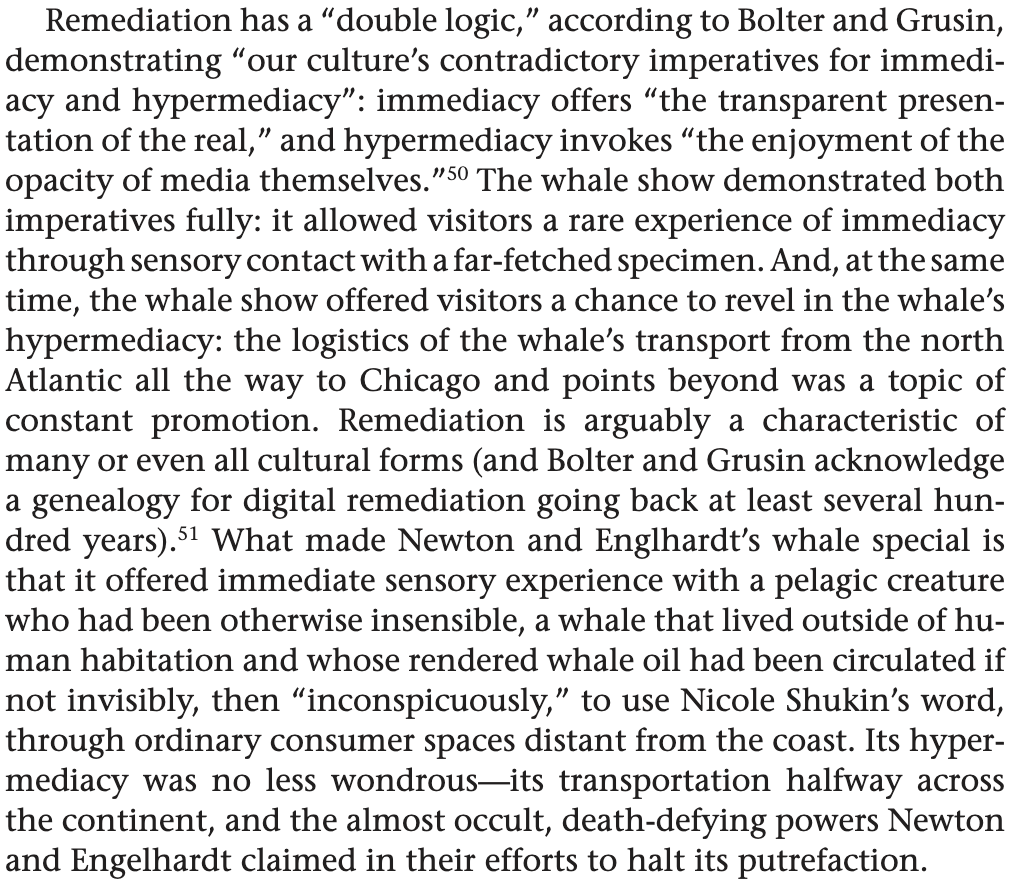
the whale itself was constantly remediated…transformed through death and putrefaction and also through various attempts at arresting putrefaction through freezing, chemical treatment, and taxidermy.
jamie l. jones, “fish out of water: the ‘prince of whales’ sideshow and the environmental humanities”, configurations 25(2) (2017). https://dx.doi.org/10.1353/con.2017.0012
![The media infrastructure approach is especially resonant in the case of the Prince of Whales, whose message was inseparable from its materiality, and whose means of transmission was a continent-wide assemblage of trains, railroads, and human and animal labor teams.&10;And, as the foregoing narrative demonstrates, the whale itself was constantly remediated: the whale was transformed through death and putrefaction and also through Newton and Engelhardt's various attempts at arresting putrefaction through freezing, chemical treat-ment, and taxidermy. Jay David Bolter and Richard Grusin theorized remediation as a way of understanding new digital media, but their ideas enable new understandings of the whale show as well.[48] Bolter](https://cdn.uploads.micro.blog/304411/2026/screenshot-2026-03-15-at-16.22.11.png)
the loss of my sinister
we make hay out of the light inside the cabin: reedy, aching culms of chartreuse rattling sympathetically with each bump and wending in the rails. my limbs on the left have gone awol again in a frustratingly and overly familiar loss of my sinister. this time, they have vanished from sight and are not merely non-responsive. i can’t see my wrist and knuckles despite the searing and swelling that renders them useless. the crystals lining the tunnel shimmer back through the window onto your tunic and catch in your necklace. a few beams find their way across your skin and mine, making nests and warrens along the way. they tickle my cheekbones and the bridge of my nose and you expectantly wait to see if a sneeze will be coaxed out of me.
that we are on this journey is nothing short of a miracle given my loss of the sinister becoming unremitting. last month i nearly sacrificed all my belongings as i ran through another station much like the one we departed from. i lost my footing on the cool marble of the staircase, fell forward, and my bag fell from my shoulder, over the balustrade, splitting open when it landed on the floor below. the clatter of nutshells reflected off the ground and the windows as they spilled forth through the threadbare duckcloth. all the other itinerants making their way to the trains below us circled their wagons of empathy. some travelers avoided any proximity, but those who didn’t remained unaware of the nutshells that split and crepitated under their feet.
you gaze along the edge of my eyelids as if to read me from the outside in. after averting my eyes, i glance back through despondent breaths. the last time i saw you was before the loss of my sinister, when you let me know how my left side was my best side. well before the words had even reached my ears i knew your fondness for that hand and wrist, watching it become swallowed by the depths of any vessel it found its way inside. my grief crackles off my lashes through the cabin and you hear my loss reeling out of me. you shift in your seat, searching for something without looking or using your hands. the corners of your eyes contract as we stay silent. i close my eyes as the hospitality of sunlight spreads across the back of my neck. as we drift into the countryside, i feel you grab and envelop my left hand. i wonder if i’m dreaming as the servos in my wrist and elbow whirr into position.
« is there a possibility that laundry can be redeemed as an art, a cultural form? if there is an aesthetic of cookery, can there be an aesthetic of the care and cleaning of clothing! »
aritha van herk, “invisibled laundry,” signs 27(3), 2002
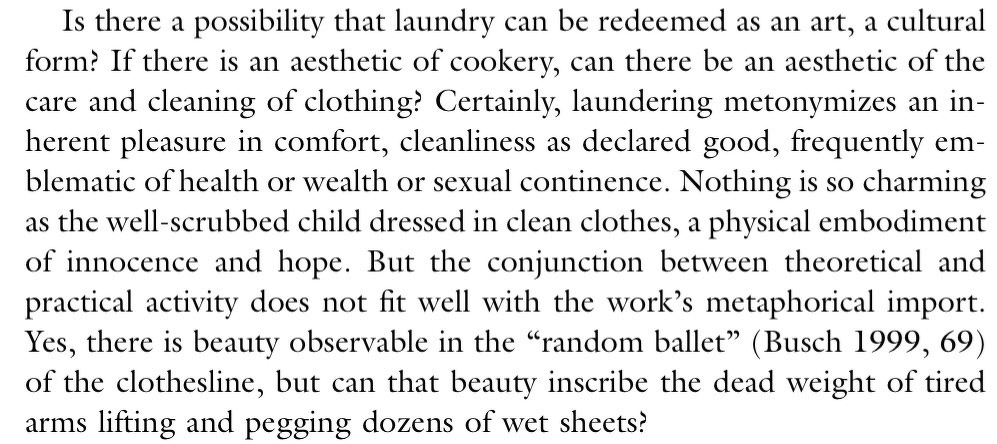
![Laundry persists as a metaphor for secrets, and tied to its degenerate reputation is laundry's implicit association with the erotic. Of course, because laundry deals with the most private and suggestive articles of apparel, it rubs elbows with fetishism. Further, the physical situation of women washing has traditionally been seen as a site of opportunity (Odys-seus again!): "Wherever women were found in isolation, there was the potential for rendezvous. Throughout history, the place where laundry gets done-be it by the creek or in a freestanding shed-has been the province of a courtship" (Busch 1999, 62). And so, doing the laundry came to be associated with sexual experimentation and freedom. "Typical meeting places for women alone, like public laundries and spinning rooms, were feared to give rise to slander and intrigue and secret liaisons" (Warner 1994, 35). In the laundry, stories were produced and reproduced. This space, then, can be read as imaginatively dangerous, breeding a miasma of fictional and sexual exhalations. In contemporary terms, too, the laundromat (Margaret Atwood's novel The Edible Woman [1969], the film My Beautiful Laudrette [1985]) becomes a safe place for cruising: "just by glancing at a woman's wash, [a man] could discern the relevant facts of her life" (Busch 1999, 63).](https://cdn.uploads.micro.blog/304411/2026/2fdba8e510.jpg)
🍿 numbskull revolution (dir. jon moritsugu, 2026)

dude, trust me. let’s get skullfucked now.
conceptual art: continuum from genius to bullshit. where it lands depends on the state of the artist. DV with lofi greenscreen lands this squarely in “hyperpop cinema.”
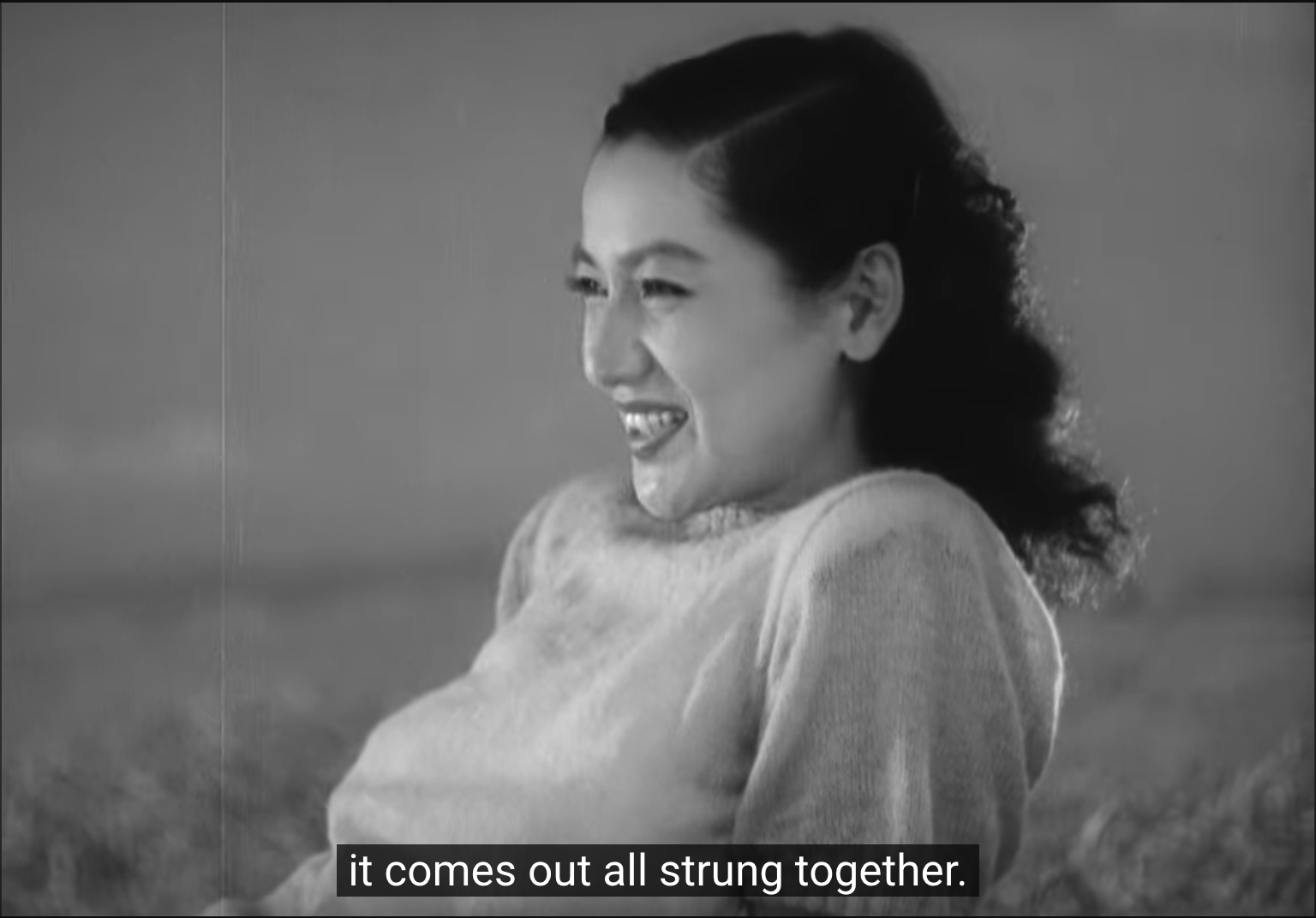
🍿 late spring (dir. yasujirō ozu, 1949)
![a still from ozu's "late spring" of noriko (setsuko hara) at the beach with hattori (jun usami; off-screen), where noriko is smiling and is saying "[as the saying goes,] when i sliced pickled radish ..."](https://cdn.uploads.micro.blog/304411/2026/screenshot-2026-03-12-at-13.25.55.png)
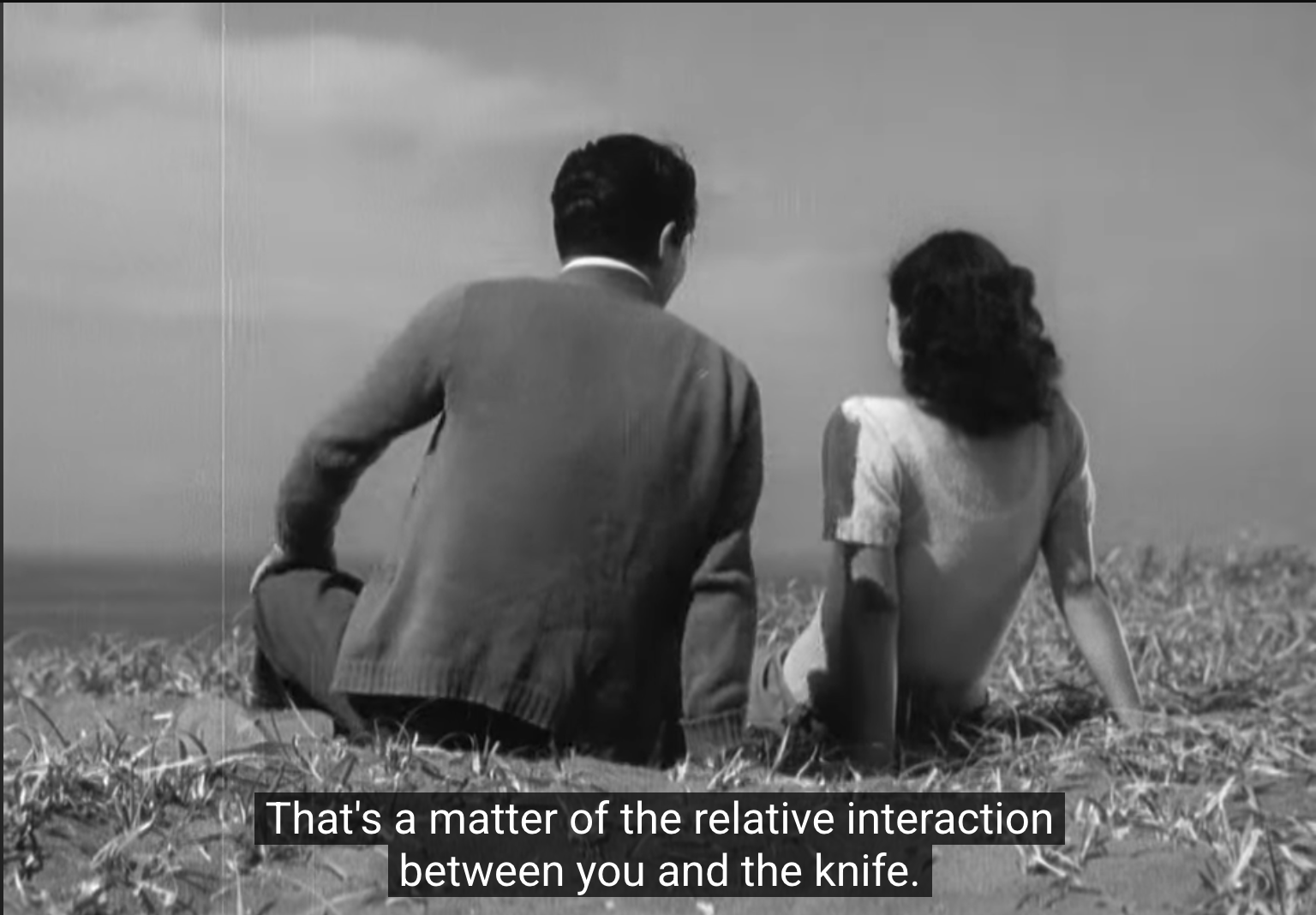
the petals accrue underneath my tongue, between incisors, incising into gum and bone. smooth, polished.
ecayed
a leaf on its last twinge,
bereaved til the next year
a manicule: for word usage,
fantastical, perplexed gesture
a pointer toward storage,
lost among typed text here
limekiln
for s.o.
slaking into mortar
    clarifying to sweet
    enrobing nixtamal
    engulfing the plaster

bury me, slowfire the
    lazy kiln, await my
    bones as kindling, for your
    duty peals in cycles
the river's bed
down from the dam, i slithe, bedward
and ferrous-tongued – magnets draw
blood to the perimeter
a mother’s patience dries up
daughters slip into thick pools
bikini snags batholith
and meets its fluvial end
no hands (your green hand)
she consulted the list of things that can fill her up and none of them are at hand. there is little greenery to be tended to by a knowing hand ready to spritz malathion and other heady organosphosphates. the space between her ribs, vacant: enough to slide in a few fingers to have someone crack her open and back to life. her heart hangs low, putrescent, absorbing obstinance. vines slither listlessly and graze the spaces between her toes, encountering little resistance.
three days later she is prone in an a clearing. all she wants is the short grass to grow tall through her bones, to become thicket with constancy. instead of her ribs, her pupils unfurl themselves into deep water and receive the fruits of the sky. the fibers begin revealing themselves as rosy, lavender, and violet threads that hang as rope ladders. instead of being absorbed into the earth, she senses the needles tatting these threads into the gaps of her skeleton.
eleven days later: the brown tangle of weeds have parted from her sternum. her costal cartilage has become supple, yet flecked with the inky remains of the tannins from the stems that bound her. her rib-gaps widen, enough for a hand’s-breadth, she estimates. a bouquet on the horizon finds its vase, full of cool water to be absorbed by each thirsty stele. obscured by the growth, the gardener’s hands find the first buds along the cartilage of her sternum. in a flash, the gardener’s secateurs violently loose the buds to ensure greater florescence.
notes on breviary
what we do is the work of the goddesses, but of most, we have an ongoing responsibility to abrade the searing, rough hours into cool, peaceful, and tranquil moments. this is the sweeping the paths of the sediment that accrues: using our powers of observation to observe, earnestly, how the secondhand ticks and the moon and the stars bite at the sky.
the process goes something like this: one. the choirmistress notes the appropriate hour of the day. that is to say: lauds, prime, terce, sext, none, vespers, compline; plus rarely, vigil and matins. as st. symeon of thessalonica writes: we aim for /seven/† as it equals the number of gifts of the spirit. two. the choirmistress finds our hymn from the great psalter (perhaps through divination, description of affect, or some other mystical means). three. the choirmistress turns to the great book and find a passage that ties to the hymn. four. the choirmistress records it in the register, sing out to the world, and wait for the next hour to arrive.
despite it having a presence in the public world, we undertake this ritual practice for ourselves, first, to lead the surroundings antiphonically. a response is neither guaranteed nor expected. nonetheless, an echo or a refrain in response occasionally finds its way back to the choirmistress, who records it in the register and moves on. but as we will soon see, this is merely a catalog, not the content.
the details in the register are intentionally scant. the specifics of memory do not much matter to the goddesses, because it is theirs to hold, and not ours. however, it does provides us with a guide and catalog to document our observances and devotions and to make new memories by turning tot the matter of the old. in this way, it is a memorial without memory, one whose stones and tablets exist to be resurfaced, polished, reshaped. the trace underneath will always remain even though we can only see glyphs and not words.
† seven is a loose goal. we are always already observing-observant, and even if not actively being written in, the register inscribes itself through our observations.
no answer/five years
hi, it’s ________. i can’t come to the phone right now. leave a message and i’ll call you back.
she thinks of a sound that someone might not have heard before. she clears her throat and tries to speak slowly and lucidly.
hey. i don’t know where you are, or what you’re doing. i wanted to wish you a happy five years.
the marks of each year fell out of her handbag: tiny azure-purple dots, each the size of a pinhead; long swabs; mulch; sky-blue candies; a seam ripper; long forgotten keys. most of these things no longer mattered or had a use.
it’s hard to help celebrate the future when the present seems uncertain.
she remembered the terror of getting it wrong. all of it. her words, her actions, her ability to care. she didn’t know how to, she thought, and read every last attachment she was forwarded.
i just want you to know we really do care about you, but this is for the best.
there would be not much to celebrate in five years' time, she thought, as the contents of her bag clattered on the tile. she told herself that she saw little things to rally around. small victories leading to learned, constructive selflessness: a panoptic heart.
it’s hard to look away. this is no longer my garden.
she was trying to figure out a way to close that tired eye. she stopped looking for patterns and puzzles that would let her get it right. she stopped worrying about getting it wrong because there were too many chances to get it right just slipping from her grasp.
she thinks of someone experiencing the shortest day for the first time, tasting raspberries for the first time, seeing the water for the first time. she remembers how it feels not to answer because you’re so in the thick of it that you lose all language.